
Kirthar National Park
Gorakh Hill |
Keenjher Lake |
Lal Suhanra National Park | |
|
||||||||||||||
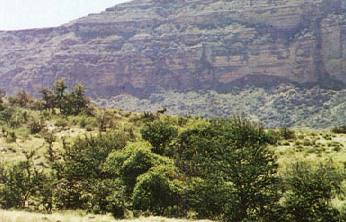
Kirthar National Park is Pakistan's second biggest National Park (Hingol National Park being the biggest now). It is also the first National Park from Pakistan to be included in the 1975 United Nation's list of National Parks around the world. Kirthar is an area of outstanding beauty and cultural heritage which provides important habitat for a variety of mammals, birds and reptiles characteristic of the arid subtropics Approximately one third of the park lies in the north of Karachi district and two thirds in the south-west of Dadu district. The park is part of a 447,161ha protected areas complex, being contiguous with Mahal Kohistan Wildlife Sanctuary (70,577ha) to the south and Hab Dam Wildlife Sanctuary (27,219ha) to the south-west. Surjan, Sumbak, Eri and Hothiano Game Reserve (40,632ha) lies just to the east of the park. There are two tourist centers in the Park managed by Sind Wildlife Management Board, namely Khar and Karchat. The centres offer cottage and dormitory accommodation and guides are available. There are some 671km of unmetalled roads within the park, most of which are negotiable only by four-wheel drive vehicle.
Wildlife:
In 1977, 1,480 wild goat and 430 urial were counted in the park and 2,141 chinkara in the park and adjacent Surjan, Sumbak, Eri and Hothiano Game Reserve. There are now over 5,000 wild goat, about 1,250 urial and less than 150 chinkara in the park, and a further 400 wild goat and 70 urial in the game reserve . A helicopter survey conducted in November 2000 yielded estimates of the total populations of the three large indigenous ungulates in the park. The Sindh ibex population was estimated at 13,155 ± 2460, and concentrated on the Khirthar Range, with lower concentrations on Khambu and Dumbar and small numbers elsewhere; higher elevations appear critical to this species. The Sindh urial population was estimated at 10,425 ± 675 and concentrated on rocky sites with characteristic vegetation mainly near Khar and at Dumbar, with small numbers elsewhere. The chinkara population was estimated at 1060 ± 580 and concentrated in the lowlands, sharing much of its habitat with farming. The KNP populations of all three species are of conservation importance. In October 1984, 15 blackbuck from the USA were brought to Khar visitor centre for captive propagation . It is planned to introduce the species to the park.
Mammals:
Total species: 34
Mammals in the park include--------Sindh leopard (T), Stripped Hyena (T), Desert Wolf (T),
Indian Fox (C), Sind Wildgoat (C), Blandford's Urial (V), Honey Badger (R), Indian
Pangolin (R), Caracal (T), Jungle cat (C), Jackal (C), Chinkara Gazelle (V), Black Buck (
Reintroduced ) (R), Hedgehog (C), Porcupine (C), Indian Grey Mongoose (C), Cairo Spiny
mouse (?) and the Rock Mouse (C).
Note: T=Threatened, V=Vulnerable, R=Rare, C=Common, ?=Unknown.
Birds:
Total species: 58
Birds in the park are-------Lammegier vulture ( Winter migrant ), Bonnelli's eagle,
Imperial eagle, Tawny eagle, Golden eagle, Eurasian griffon vulture, Egyptian vulture,
Cinereous vulture, Lagger falcon, Red-headed merlin, Kestrel, Close-Barred sandgrouse,
Houbara bustard, Grey partridge, See See partridge, Stone Curlew, Indian sand grouse,
Coronetted sand grouse, Painted sand grouse, Eagle owl , Sind pied woodpecker, Hume's
chat, Brown rock pipit, Striped buning, Finche larks, Hoopoe, Shrikes and Wheatears.
Reptiles:
The Rock python, Sind cobra, Russell's viper, Saw-scaled viper, Sind krait, Royal rat snake, Tortoises, Desert Monitor lizard, Yellow Monitor lizard, Sind Crocodile (Possibly extinct) and different species of lizard and chameleon.
Credits:wildlifeofpakistan.com



Advertisement
Advertise on this site click for advertising rates