
Last 60 Days of Quaid E Azam Mohammad Ali Jinnah
It was July 14 1948 when the then Governor General Mohammad Ali Jinnah was moved to quetta due to his illness, after that he only lived 60 days on September 11th, 1948 he passed away. This article is about those 60 days of father of Pakistan
This mysterious conundrum has not been solved till date as to who advised 'Quaid-e-Azam' Muhammad Ali Jinnah to move from Quetta to Ziarat due to serious illness.
Ziarat is famous all over the world for its Junipar trees and is located at an altitude of 2449 meters, it is 133KMs away from Quetta. Ziarat is named upon a shrine of a sufi saint Kharwari Baba. Quaid E Azam residency was located 10 km from Ziarat
His sister Fatima Jinnah has written in her book 'My Brother' that the decision to move from Quetta to Ziarat was a personal decision of Jinnah as he was not getting a chance to rest in Quetta due to his official and non-official engagements. He was constantly receiving invitations from various institutions and leaders to attend and address his gatherings.
However, it remains to be seen who told Jinnah about the pilgrimage and who advised him to move there.
July 13-21: Avoiding doctor's advice
Even after reaching Ziarat, he did not pay attention to treatment from any qualified doctor but in the same days it was reported that famous Dr. Riaz Ali Shah had come to visit one of his patients. Fatima Jinnah told her brother that the visit of Dr. Riaz Ali Shah should be taken advantage of, but he vehemently rejected the suggestion, saying that he did not suffer from any more serious illness and if only his stomach was a little better. If he starts digesting properly, he will soon be healthy again.
According to Fatima Jinnah: 'He always avoided the advice of doctors on what to do, what to eat, how much to eat, when to sleep and how long to rest. This same old habit of avoiding treatment was happening.
But he was soon forced to give up the habit. Within a week of his arrival in Ziarat, his condition worsened to the point that for the first time in his life, his health became a source of concern for him. Until now, he thought he could control his health, but on July 21st, 1948, just a week after arriving at the Ziarat, he admitted that he no longer needs to avoid health risks. And now they really need good medical advice and attention.
Fatima Jinnah says that as soon as she came to know about her brother's intention, she sent a message through her private secretary Farrukh Amin to Cabinet Secretary General Chaudhry Muhammad Ali asking him to send a letter to Dr Colonel Elahi Bakhsh, a prominent physician from Lahore. Arrange for a plane visit.
July 23 to July 29: Secrets hidden in a Bombay vault
Dr. Elahi Bakhsh reached Quetta on July 23rd, 1948 and then from there by car, but despite traveling all day, it was evening when he reached Ziarat and his meeting with Jinnah was possible only the next morning. He wrote in his book: "When I inquired from the Quaid about his illness, all his emphasis was on the fact that he was fine and that his stomach would recover soon. He will start working as usual.
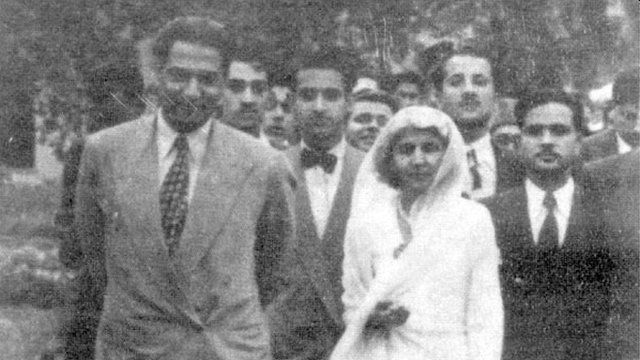
But when Dr. Elahi Bakhsh examined Jinnah, he came to the conclusion that his stomach was fine but the condition of his chest and lungs was not satisfactory. On the advice of Dr. Elahi Bakhsh, Dr. Siddiqui, a civil surgeon from Quetta, and Dr. Mahmood, a clinical pathologist, arrived in Ziarat the next day with the necessary equipment and supplies. He immediately tested Jinnah, the results of which confirmed Dr Elahi Bakhsh's fears that he was suffering from tuberculosis.
Dr. Elahi Bakhsh first informed Fatima Jinnah about Jinnah's illness and then on her instructions his patient was also informed. Dr. Elahi Bakhsh writes: "I was deeply moved by the way the Quaid-e-Azam heard my assessment."
In an interview, Chaudhry Muhammad Hussain Chatha told Zameer Ahmed Munir that when Dr. Elahi Bakhsh told Jinnah that he was suffering from tuberculosis, Jinnah replied: 'Doctor, I have known this for 12 years. I did not show my illness just so that Hindus would not wait for my death.
Larry Collins and Dominic Lapierre, authors of the famous book "Freedom at Midnight" on the subcontinent's struggle for independence, have rightly stated: Knowing the extraordinary secrets that were kept in the vaults of the offices of Dr. JAL Patel, a famous physician in Bombay, India might never have been divided and today the tide of Asian history is flowing in a different direction. Would have It was a secret the British Secret Service was not familiar with. The secret was an X-ray of Jinnah's lungs, in which two large spots the size of a table tennis ball were clearly visible on the lungs of the founder of Pakistan. There was a spear around each spot which made it very clear how aggressively tuberculosis had invaded Jinnah's lungs.
Dr. Patel never told anyone about these X-rays at Jinnah's request. However, he did advise Jinnah for treatment and recovery that his cure lies solely in rest. But where did the founder of Pakistan have time to rest?
He had little time and a lot of work and could never arrange regular treatment. He had such an iron will that he did not even tell his dearest sister about his illness, not even telling Dr. Elahi Bakhsh his secret at the time when he himself had made the same diagnosis.
Mountbatten later told Larry Collins and Dominic Lapierre in an interview that all power was in Jinnah's hands. "If someone had told me that they would die in a very short time, I would not have allowed India to be divided. It was the only way for India to remain united. The only cornerstone was Mr. Jinnah, the other leaders were not so inflexible and I am sure that the Congress would have reached an understanding with them and Pakistan would not have come into existence.
Dr. Elahi Bakhsh writes: 'When the disease was diagnosed, on the one hand, I made appropriate adjustments in treatment and diet, and on the other hand, telegraphed from Lahore to Dr Riaz Ali Shah, Dr SS Alam and Dr Ghulam Muhammad that they needed the necessary equipment. Arrive in Ziarat immediately with luggage and travel X-ray equipment.
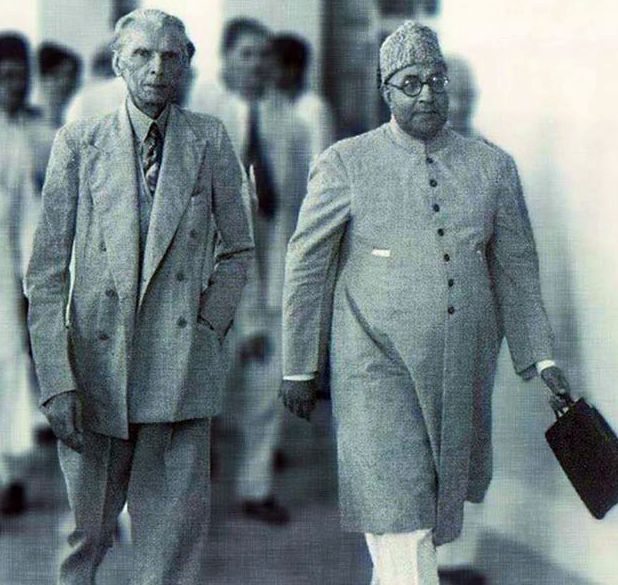
With Liaquat Ali Khan
July 30: Meeting with the Prime Minister and refusal of Jinnah to take medicine
On July 30, 1948, all of Jinnah's physicians arrived in Ziarat. The day before, a trained nurse from Quetta, Phils Dulham, had also been invited to visit the Father of the Nation. Now, God forbid, the possibility of Jinnah's regular treatment had arisen that an incident had taken place on the same day on which there are still mysterious veils of silence and those who are aware of it insist that this The incident should still be kept a secret.
This incident was first recorded by Ms. Fatima Jinnah in her book 'My Brother'. He wrote this book with the help of G. Allana. After his death, the draft became available in papers now preserved in the National Archives of Islamabad.
The draft was published in book form by the Quaid-e-Azam Academy, Karachi in 1987, but the paragraphs that she had written in reference to an incident that took place on July 30, 1948 were omitted from the book.
She wrote in her book: 'One day in late July, Prime Minister Liaquat Ali Khan and Chaudhry Muhammad Ali paid a surprise visit without any prior notice. The Prime Minister asked Dr. Elahi Bakhsh what was his diagnosis of Jinnah's disease. The doctor said that he had been called by Fatima Jinnah and he could only tell her about his patient. The prime minister insisted that he, as prime minister, was concerned about the health of the governor-general, but that Dr Elahi Bakhsh's position was that he could not tell anyone without his patient's permission.
Fatima Jinnah further writes: 'I was sitting next to my brother when I was told that the Prime Minister and the Secretary General of the Cabinet wanted to meet him. When I informed my brother about this, he smiled and said, Fati! "You know why he came here. He wants to see how serious my illness is and how long I will live."
A few minutes later, he said to his sister: 'Go down ... Tell the Prime Minister that I will meet him too.
Fatima Jinnah asked her brother, "It's too late, you will meet him in the morning." But Jinnah ordered, "No ..." Let him come now, let him see for himself. '
She writes: 'The meeting lasted half an hour. As soon as Liaquat Ali Khan came back downstairs, I went upstairs to my brother. He was very tired and his face was downcast. They asked me for fruit juice and then invited Chaudhry Muhammad Ali inside who stayed with them for 15 minutes. Then when they were alone again, I went inside to them. I asked if he would like some juice or coffee but he did not answer. He was deep in thought. So it was time for dinner. The brother said to me, 'You better go downstairs and eat with them.'
"No," he insisted, "I'll sit next to you and eat here."
'No,' said the brother, 'it's not fair. They are our guests here, go and eat with them. '
Fatima Jinnah then writes: 'At the dinner table I found the Prime Minister in a very happy mood. They were telling jokes and laughing while I was trembling with fear for the health of my brother who was lying on a sick bed upstairs. During the meal, Chaudhry Muhammad Ali was silently lost in thought. I went upstairs before the meal was over. When I entered the room, my brother smiled at me and said, 'Fati, you must work hard.' I tried hard to hide the tears that came to my eyes.
On October 17th, 1979, an article by Sharifuddin Pirzada was published in the Pakistan Times Lahore entitled 'The Last Days of the Quaid-e-Azam'. In this article, he cites a letter from eminent jurist MA Rehman.
In the letter, MA Rehman had written to him that Humayun Khan, son of Dr Colonel Elahi Bakhsh, had also told him about the incident. According to this tradition, the effect of the medicine on the Quaid-e-Azam was becoming very favorable and he was gradually recovering. One day Liaquat Ali Khan came to visit Quaid-e-Azam. He stayed with them for about an hour. At that time it was time to give medicine but my father could not go inside and give medicine to Quaid-e-Azam because the meeting that was taking place inside was very secret. So they waited outside so that they could give medicine to Quaid-e-Azam as soon as the meeting was over.
When Liaquat Ali Khan left the room, my father immediately entered the room and wanted to give medicine to Quaid-e-Azam. He saw that Quaid-e-Azam was suffering from severe anxiety and depression and he refused to take medicine and said that he did not want to live anymore. After that, despite his father's best efforts and insistence, the Quaid-e-Azam refused to cooperate with his doctor.
Humayun Khan added: 'Immediately after the death of Quaid-e-Azam, Liaquat Ali Khan sent for my father. Liaquat Ali Khan asked him what Quaid-e-Azam had said to him when he came out of the room on the day of Ziarat and he went inside. My father tried to reassure Liaquat Ali Khan that the Quaid had not spoken to me about the conversation between the two of you except that the Quaid had stopped taking medicine after that, but Liaquat Ali Khan was not satisfied with my father's answer.
Liaquat Ali Khan kept trying to subdue my father for a long time. When their meeting ended and my father started to leave the room, Liaquat Ali Khan called him back and warned him that if he heard anything about this meeting from any other source, he, my father, would face serious consequences. Will have to suffer.
This is the narration narrated by Humayun Khan, son of Dr. Col. Elahi Bakhsh, which has reached us through AR Rehman and Sharifuddin Pirzada. His health may be debated because Dr. Colonel Elahi Bakhsh himself has made a different statement in his book 'The Last Days of Quaid-e-Azam'.
He writes: 'When I went downstairs, the Prime Minister met in the drawing room. He had accompanied Mr. Muhammad Ali on the same day to inquire about the mood of Quaid-e-Azam. He eagerly inquired about the condition of Quaid-e-Azam and expressed satisfaction that the patient has confidence in his doctor and insha-Allah it will have a good effect on his health. He stressed that the root cause of Quaid-e-Azam's long illness must be traced. I assured him that despite Quaid-e-Azam's critical condition, he was hopeful that if he took the modern medicine that was being imported from Karachi, he might recover. The most promising thing is that the patient has a strong immune system. The Prime Minister was very saddened by the illness of his leader and old comrade. I was deeply moved by his heartache.
What is the reality now? Only five or six personalities who were present at the time knew about it. Unfortunately, none of them are alive now. The incident has been going on for 72 months and years and now there is no means left to inform the nation about the reality of this incident.
Fatima Jinnah and Dr. Elahi Bakhsh
July 31-August 12: Jinnah's favorite cook
In two or three days, Jinnah's condition improved so much that on August 3, Dr. Colonel Elahi Bakhsh took leave of all four of them to go to Lahore. Apparently the reason for this seems to be that Eid was coming a few days later and Dr. Elahi Bakhsh wanted to celebrate this Eid with his family.
But just a day after his arrival in Lahore, he was urged to return immediately with Dr. Alam with an ultraviolet apparatus and on August 6, he arrived with the device. Dr. Riaz Hussain Shah told him that in his absence Jinnah became very weak and his blood pressure had dropped a lot but the injection had improved his condition.
The next day, August 7, 1948, was Eid al-Fitr. The same evening, Jinnah was treated with electromagnetic radiation, but it did not work out and his legs became swollen.
On August 9, the doctors opined that the height of the pilgrimage was not good for the patient and he should be shifted to Quetta. Jinnah was initially reluctant to travel before August 15 because it was decided in June of that year that Independence Day would be celebrated on August 14 instead of August 15. But at the insistence of his doctors, he agreed to go to Quetta on August 13.
At the time of Jinnah's visit, Dr. Colonel Elahi Bakhsh asked Fatima Jinnah: "How can you persuade your brother to eat something? Tell him something special."
Fatima Jinnah said that she used to have a cook in Bombay who used to prepare some food that her brothers used to eat with great relish, but after the formation of Pakistan, that cook went somewhere. He remembered that he was a resident of Lyallpur (now Faisalabad) and said that maybe he could get some information from there.
Hearing this, Dr. Sahib requested the Punjab government to find the cook and send him on a pilgrimage immediately. Somehow the cook was found and he was immediately sent on a pilgrimage, but Jinnah was not told about his arrival.
At the dinner table, they were surprised to see their desired food and ate a good meal. Jinnah asked who made these dishes today. His sister said that the Punjab government has found our Bombay cook and sent him here and he has made the food of your choice.
Jinnah asked his sister who had paid for the search for the cook. He said that this deed has been done by the Punjab government and no one else has spent it. Jinnah then called for a file on the cook and wrote on it, "It is not the job of any government agency to provide the cook and food of the governor general's choice." Details of expenses should be prepared so that I can pay it out of my own pocket 'and then it happened.
Visiting 'Quaid-e-Azam Residency'
August 13 to August 28: Recovery and readiness to return to Karachi
When Jinnah returned to Quetta on the evening of August 13th, 1948, after a month's stay in Ziarat, he said to his physicians: 'Well done for bringing me here. During the stay in Ziarat, I felt like I was locked in a cage.
After arriving in Quetta on August 16, his doctors again took X-rays and other tests. X-ray results showed that Jinnah's health was gradually improving, and test results reinforced that view. So the doctors allowed Jinnah to read the newspapers to keep him busy and he was not even barred from handling some office files.
After arriving in Quetta, Jinnah's health had improved so much for a few days that he started working one hour a day without feeling tired. His stomach was also working better, so much so that one day he ate halwa puri kurwa despite the advice of doctors. A few days later, he started smoking with the permission of doctors. Doctors believed that if a regular smoker asked for a cigarette during his illness, it was a sign of his return to health.
Now the doctors further examined Jinnah's health and asked him to move from Quetta to Karachi but Jinnah, lying on a stretcher, did not want to go to the Governor General's House.
When he was repeatedly requested, he agreed to go to Karachi on the condition that he would stay at the residence of the Nawab of Bahawalpur in Malir and not at the Governor General's House. In those days the Nawab of Bahawalpur was residing in England.
Jinnah was told that he would have to write a letter to stay at his residence, but his principledness did not allow him to do so. He did not want to seek formal permission from the Nawab of a state in his country to get any kind of facility while he was the Governor General of the country.
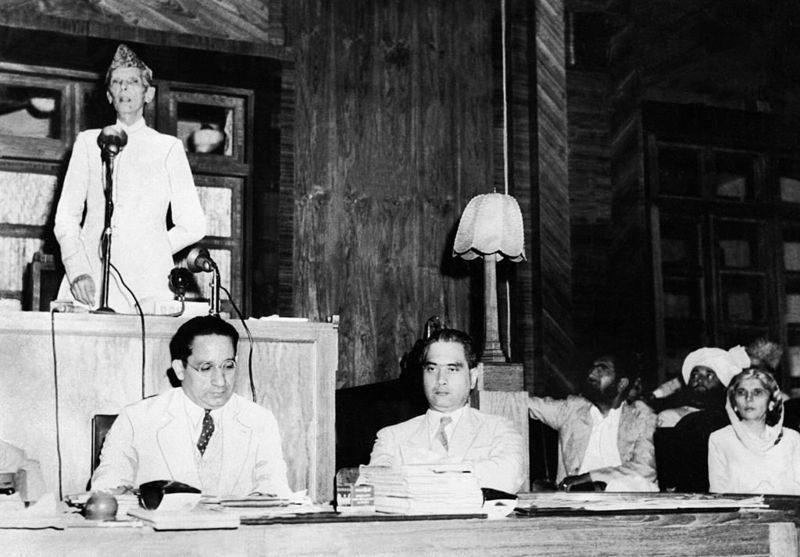
Jinnah's first speech to the Assembly after the formation of Pakistan on August
15, 1947. Fatima Jinnah can also be seen to her right
August 29: 'I'm done'
On August 29th, 1948, Dr. Elahi Bakhsh examined Jinnah again. He writes: 'After inspecting the Quaid-e-Azam, I expressed the hope that the state you have created will live on for a long time to fully stabilize and consolidate it. It didn't even occur to me that they would be saddened by my feelings. I will never forget his words and his depressing and depressing tone.
Addressing Dr Elahi Bakhsh, Jinnah said: "You remember, when you first visited, I wanted to live but now my death is equal to my life."
Dr. Elahi Bakhsh writes that tears came to his eyes when he uttered these words. Dr. Elahi Bakhsh was stunned to see such a person, who was considered completely devoid of emotions and as hard as steel. Jinnah was gradually recovering at the time, so he was even more surprised by Jinnah's debilitated nature. Asked why, Jinnah said: "I've done my job."
Dr. Elahi Bakhsh writes: "This answer only confused me and made me think that they want to keep the real thing secret and the reason they have given is to avoid it. I kept wondering if his work was incomplete five weeks ago today and has now suddenly come to completion. I couldn't help but feel that there was something that had made him not want to live.
The same story is written by Fatima Jinnah, but in slightly different words. She writes: 'In the last days of August, Jinnah was suddenly overwhelmed with despair. One day, looking me in the eye, he said, 'Fati ... I'm not interested in living anymore. The sooner I leave, the better.'
"It simply came to our notice then. I shuddered, as if I had touched a bare electric wire. Still, I worked patiently and said: Jinn! You will get better soon. The doctors have high hopes.
He smiled when he heard me say this. Maroni was hidden in that smile. He said: No ... I don't want to live anymore. '
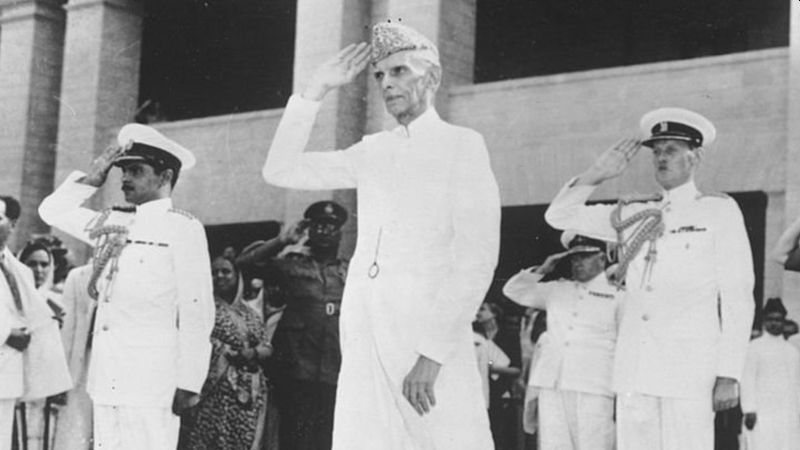
Jinnah
Taking salute
September 1st to September 10th: Hemorrhage and preparations to return to Karachi
On September 1, 1948, Jinnah wrote a letter to General Douglas Gracie, the Chief of Army Staff, from Ziarat, which unfortunately turned out to be his last. In the letter, he wrote: 'I have sent a copy of your letter to the Vice President of the Quaid-e-Azam Relief Fund and I have approved a grant of Rs 300,000 from this fund to the refugee soldiers of Thal Project Is for the welfare of.
On the same day, Dr. Elahi Bakhsh in a disappointed tone told Ms. Fatima Jinnah that her brother had suffered a hemorrhage and he should be taken to Karachi immediately as the height of Quetta was not suitable for him. In the days that followed, Jinnah's condition worsened. On September 5, doctors diagnosed him with pneumonia.
Dr. Elahi Bakhsh wrote to Pakistan's Ambassador to the United States Mirza Abul Hassan Isfahani to send some doctors for Jinnah. The names of these doctors were suggested by Dr. Fayyaz Ali Shah. Meanwhile, Dr. Elahi Bakhsh also called Dr. Mistry from Karachi to Quetta, but despite this, Jinnah's health did not improve and his health continued to improve.
These are the days when Jinnah's secretary Farrukh Amin wanted to meet Jinnah, but Dr. Elahi Bakhsh refused to allow him to do so despite his repeated insistence. Dr. Elahi Bakhsh wrote that he was not told the name of the visitor but the then Prime Minister of Hyderabad Deccan Mir Laiq Ali in a chapter of his book 'Tragedy of Hyderabad' entitled 'Jinnah on Death Bed' Yes, I wrote that these visitors were themselves, but despite insisting, they could not meet Jinnah.
On September 10, 1948, Dr. Elahi Bakhsh informed Fatima Jinnah that there was no hope for Jinnah to survive and that he was only a guest for a few days.
Jinnah probably fainted that day. In this world of unconsciousness, irrelevant words were being uttered from his tongue. He was growing up: 'Kashmir ... Give them the right to decide ... Constitution I will complete this... Very soon... Refugees Give them everything possible ... Help me Pakistan...'
September 11th: From Quetta to Karachi in two hours, from the airport to the residence in two hours
On September 11, 1948, Jinnah was carried on a stretcher to his Wi-King plane. As he was being taken to the plane, the crew greeted him and then everyone was surprised to see that Jinnah responded immediately despite his great relief. The movement of his hand made him feel that he was fully aware of the requirements of discipline even on his death bed.
The journey from Quetta to Karachi took two hours. Meanwhile, Jinnah was very restless. They were given oxygen again and again, this duty was sometimes performed by Fatima Jinnah and sometimes by Dr. Elahi Bakhsh.
Dr. Mistry, Nurse Dunham, Naval ADC Lt. Mazhar Ahmed and Farrukh Amin, Jinnah's assistant private secretary, were also on board. The plane carrying Jinnah landed at Maripur airport at 4.30 pm. No key members of the government were present to pick him up at Jinnah's behest, nor was the district administration aware of his arrival. Among those who greeted him at the airport was Lt. Col. Jeffrey Knowles, the governor general's military secretary.
The Governor-General's staff put him on a stretcher and transported him to a military ambulance. Fatima Jinnah and Phils Dunham sat with him, while Dr. Elahi Bakhsh, Dr. Mistry and Col. Jeffrey Jinnah boarded the Cadillac car.
Jinnah's ambulance must have traveled only four miles when its engine stopped with a jolt due to running out of petrol. Cadillac cars, trucks and other vehicles following the ambulance also stopped.
The condition of the Quaid was not such that even a moment was wasted on the way. The driver struggled to fix the engine for 20 minutes. Finally, on the orders of Fatima Jinnah, the military secretary left in his car to take another ambulance and Dr. Mistry was also with him.
There was severe confinement in the ambulance. It was also becoming difficult to breathe. Hundreds of flies hovered around Jinnah's face, unable to fly. Fatima Jinnah and Sister Dunham took turns fanning them with a piece of cardboard. Every moment was passing in great agony.
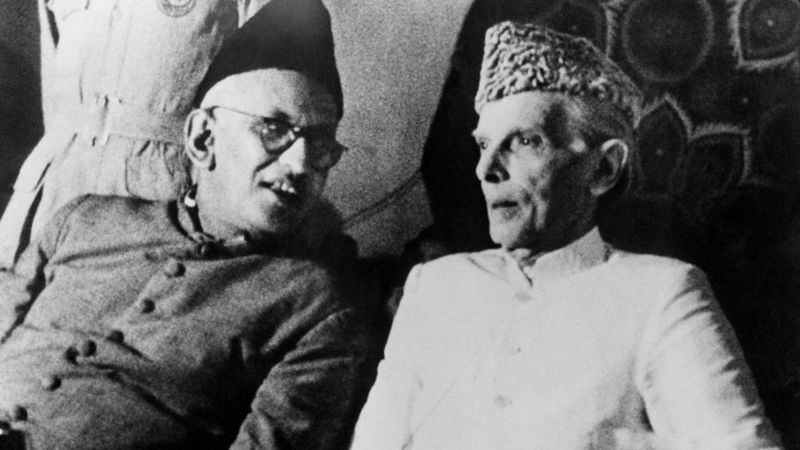
Jinnah and II Chandragar
It was too late for Colonel Knowles and Dr. Mistry to leave, but neither the engine of the military ambulance nor the engine could be repaired. Dr. Elahi Bakhsh and Dr. Riaz repeatedly saw the pulse of their leader which was gradually sinking. It is not even possible to transport the father of the nation from the ambulance to the car because the stretcher could not be placed in the car and Jinnah himself could not sit or lie in the car.
On this occasion, it is very surprising that no one in the capital even bothered to find out why Jinnah, despite landing at the airport at four o'clock, has not yet reached the Governor General's House, where his convoy is and how he is doing. Is.
Some people say that Jinnah's arrival in Karachi was kept secret but weren't the top government officials really aware of his arrival? Didn't anyone know that the Governor General's special plane has been sent to Quetta this morning and he is expected to arrive in the capital at any time in the evening?
It is learned that on September 4th, 1948, when the Secretary General of the Cabinet, Chaudhry Muhammad Ali, returned to Karachi after seeing the critical condition of the Governor General, an emergency meeting of the Cabinet was held at the Prime Minister's House that evening. It is impossible that Jinnah's illness was not discussed at the meeting.
Later, when Mir Laiq Ali returned to Karachi without meeting the Governor General, he informed Liaquat Ali Khan, Chaudhry Muhammad Ali and Sir Zafarullah Khan at Ghulam Muhammad's residence about Jinnah's very worrying condition. Laiqat Ali's "everyone was shocked."
Against this backdrop, what does the arrival of Jinnah in Karachi indicate about the helplessness and ignorance of the government? This question is still a matter of concern today.
Sri Prakash, India's first High Commissioner to Pakistan, also mentioned the incident in his book, Pakistan: Establishment and Early Situations. He wrote: “In those days, Jamshed Mehta was in charge of the local Red Cross and was respected by everyone in Karachi. He later told me that I had received a message in the evening that a man was very ill. Can you send an ambulance for that? The incident took place at 5.30 pm.
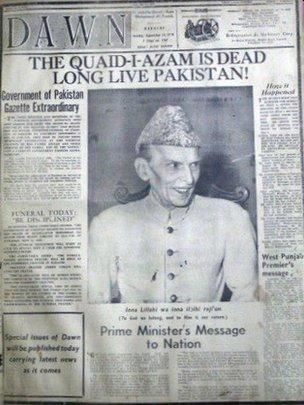
The cover of the Dawn newspaper published the day after Jinnah's death
By God, Colonel Knowles and Dr. Mistry returned with another ambulance. It can be speculated that this will be the same ambulance mentioned by Sri Prakash.
Jinnah was put on a stretcher and taken to the ambulance, where he arrived at the Governor General's House at 6:10 p.m. The nine-mile journey from the airport to the residence, which should have taken a maximum of fifteen to twenty minutes, took about two hours. That is, two hours from Quetta to Karachi and two hours from the airport to the Governor General's House.
Jinnah made this painful journey in a world of cosmopolitanism that has no precedent in our history and no justification.
Sri Prakash wrote in his book: 'At the time of Mr Jinnah's death, there was a cocktail party at the French embassy. When I mentioned the arrival of Mr. Jinnah in this party from Nawabzada Liaquat Ali Khan, he said that Mr. Jinnah is a simple-minded man, so he did not like the commotion when he arrived.
Jinnah lived for only four and a half hours after arriving at the Governor General's House, during which time he was almost drowsy.
The doctors gave him an injection of force, and according to Dr. Elahi Bakhsh, when he regained consciousness and told Jinnah that he would recover soon, he said softly: "No ..." I will not live. ' According to Dr Elahi Bakhsh, these were the last words of 'Quaid-e-Azam' Muhammad Ali Jinnah.
Dr. Riaz Ali Shah has written that Jinnah's last words' Allah ... Fatima Jinnah writes in 'My Brother': 'After two hours of restful and restless sleep, Jinnah opened his eyes, called me with his head and eyes and made one last attempt to talk to me. Out of their lips came a world of whispers: Fati ... Goodbye... La Allah Allah Muhammad Rasool Allah. Then his head slowly tilted to the right and his eyes closed.
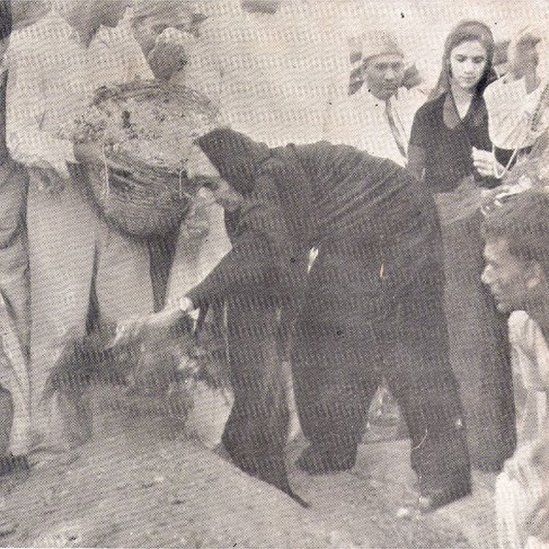
Fatima Jinnah lays flowers at her brother's shrine

Advertisement
Advertise on this site click for advertising rates