
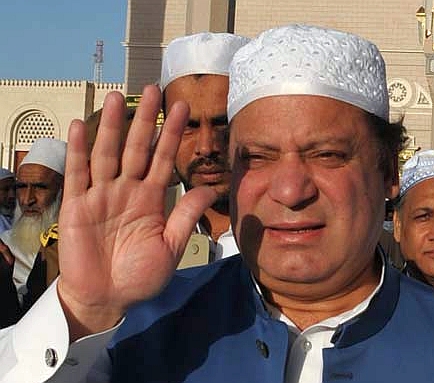
 Mian Mohammad Nawaz Sharief
Mian Muhammad Nawaz Sharif, also known Nawaz Sharif, (born December 25, 1949 in Lahore, Punjab, Pakistan) is a Pakistani politician and businessman. He is the current prime minister of Pakistan. He was twice elected as Prime Minister of Pakistan, serving two non-consecutive terms, the first from November 1, 1990 to July 18, 1993 and the second from February 17, 1997 to October 12, 1999. His party is the Pakistan Muslim League (N) (Nawaz group).
He is best known internationally for ordering Pakistan's 1998 nuclear tests in response to India’s nuclear tests,[2] and the abrupt end of his final term in a dramatic coup by General Pervez Musharraf. He is one of the richest men in Pakistan with a net worth of US$1.4 billion (2005).[3] Nawaz Sharif is also currently a strong supporter of the free judiciary movement in Pakistan and restoration of Chaudhry Iftikhar Ahmad. Ironically, it was during the Prime Ministership of Nawaz himself, when supporters of his party attacked the Supreme Court of Pakistan which eventually led to the then Chief Justice of Pakistan, Sajjad Ali Shah resigning. On November 29, 2006 his party issued a public apology for this act
Early life
Nawaz Sharif hails from a family that traces its roots to Shopian in the Kashmir
valley. His father, Muhammad Sharif, migrated in 1947 to Pakistan from Amritsar,
India. After independence Muhammad Sharif established a small business which
gradually turned into what was later known as Ittefaq Group. Nawaz was a
cricketer during his early life, and played a first class game in the 1973-74
season representing Pakistan Railways. He also played a side match against West
Indies when he was prime minister. During his premiership he used to play
cricket only as a batsman.
He married Kulsoom Nawaz, who is the grandniece of the famous Kashmiri wrestler - The Great Gama.
Nawaz Sharif was educated at Saint Anthony’s High School and Government College (Lahore), and received a law degree from Punjab University. Following his education, he entered Punjab provincial politics, joining the Punjab advisory district council. He initially joined politics in the late 1970s when he became a member of Asghar Khan's tehrik-e-istiqlal. He was then chosen by Military leader Punjab Governor Jilani as Punjab finance Minister.
He became finance minister of Punjab in 1981 and also served as minister of sports. He was credited with increasing funding for sports activities and rural projects.
The Ittefaq Group saw its unprecedented rise during the time of Gen. Zia ul Haq, who promoted Nawaz Sharif to enter politics and be his right hand man in the important province of Punjab.
Chief Minister of Punjab
Nawaz Sharif began his first term as Chief Minister of Punjab province on April
9, 1985 under the Martial Law Regime of General Zia-ul-Haq, who was his
political mentor. On May 31, 1988 he was appointed caretaker Chief Minister
after the dismissal of assemblies by Zia. After the 1988 general elections which
followed Zia’s death in a plane crash, he was again elected as Chief Minister of
Punjab. He remained in the position until he became prime minister in 1990.
Prime Minister
First term
Sharif first became Prime Minister on November 1, 1990, running on a platform of
right wing conservatives and vowing for an end to corruption. His term was thus
interrupted on April 18, 1993, when President Ghulam Ishaq Khan used the reserve
powers vested in him by the Eighth Amendment to dissolve the National Assembly
and appointed Mir Balakh Sher Mazari as the caretaker prime minister. Within six
weeks, the Supreme Court overruled the President, reconstituting the National
Assembly and returning Sharif to power on May 26. Sharif resigned from office
along with President Ghulam Ishaq Khan on July 18, 1993, after his feud with the
president, who had accused him of corruption. Moin Qureshi became caretaker
prime minister, and was succeeded shortly thereafter by Benazir Bhutto, who was
elected to office on October 19, 1993.
Currency crisis
During the early 1990s, Sharif's administration failed to arrest the 30 per cent
fall in the value of the Pakistani Rupee from 21 to 30 to the US Dollar.
Second term
Sharif returned to power in February 1997 with such a huge majority that the
result was immediately questioned by Bhutto's Pakistan Peoples Party (PPP).
Sharif won by obtaining 90 percent of the national votes cast. Doubts against
the authenticity of the national elections always persist and are nearly always
contended by Pakistan's losing party. Tony Blair stated in a January interview
that he "believed the election was true". Nawaz Sharif, therefore, holds the
record in Pakistani politics for securing the heaviest mandate in a general
election in Pakistan.
One of Sharif's first acts during his second term was to orchestrate the scrapping of Article 58-(2)(b) through another Amendment to the Constitution—an exercise in which Sharif’s party was joined by all the other political parties in the National Assembly and Senate. The Thirteenth Amendment to the Constitution of Pakistan was passed so that the President could no longer dismiss the Prime Minister; and the Fourteenth Amendment imposed strict party discipline on members of parliament. This allowed party leaders to dismiss any of their legislators if they failed to vote as they were told and made it nearly impossible to dismiss a prime minister by a motion of no confidence. In effect, the two amendments removed nearly all checks on the prime minister's power, since there was virtually no way for him to be legally dismissed once elected. On November 28, 1997, the Chief Justice Sajjad Ali Shah of the Supreme Court was dismissed against revolt of other judges, orchestrated by Sharif's younger brother, Shahbaz Sharif, and the Chief Minister of Punjab, Justice Rafiq Tarar. On this issue he fell out with President Farooq Ahmed Khan Leghari who, now without the powers to act against the Prime Minister, also resigned. Rafiq Tarar was rewarded by his being appointed President of Pakistan.
In August 1997, Sharif signed the Anti-Terrorist Act which established Anti Terrorism Courts (ATC). The act was judged in 1998 unconstitutional by the Supreme Court (Merham Ali vs Pakistan). Sharif then enacted an amendment to the law to take into account the judges' critiques.
Nawaz Sharif's downfall coincided with his secular actions such as abolishing Friday holidays, distancing him from the conservative religious right wing establishment without taking him closer to the secular section, which preferred the PPP of Benazir Bhutto. Even now his frequent assurance to the west about continued cooperation is diminishing his popularity at home amongst the right wing conservatives who are looking for an alternative candidate to counter the secularist alliance of Musharraf-Benazir duo in the coming elections.
On the development front, Nawaz Sharif completed the construction of South Asia's longest motorway, the 367 km M2, linking Lahore and Islamabad. The motorway, which was initiated during Nawaz Sharif's first term, was inaugurated in November 1997 and was constructed at a cost of Rs 37.5 billion.
The peak of Sharif's popularity came when his government undertook nuclear tests on 28 May 1998 in response to India's nuclear tests two weeks earlier. However, after these tests, matters started going downhill. He suspended many civil liberties, dismissed the Sindh provincial government and set up military courts when the stability of the government was threatened.
U.S. Defense Secretary, William S. Cohen, with Prime Minister Nawaz Sharif, at the Pentagon, December 3, 1998.
Nawaz Sharief's Relations with the military
During his first term as prime minister, Sharif had fallen out with three
successive army chiefs: with General Mirza Aslam Beg over the 1991 Gulf War
issue; with General Asif Nawaz over the Sindh "Operation Clean-Up" issue; and
with General Wahid Kakar over the Sharif-Ishaq imbroglio.
It was under Wahid Kakar that Nawaz Sharif along with the then President of Pakistan Ghulam Ishaq Khan were forced to resign in 1992-93.
At the end of General Waheed’s three-year term in January 1996, General Jehangir Karamat was appointed army chief. His term was due to end on January 9, 1999. In October 1998, however, Sharif fell out with General Karamat as well, over the latter’s advocacy of the need for the creation of a "National Security Council" in what Sharif believed was a conspiracy to return the military to a more active role in Pakistani politics. Before that Sharif dismissed the Chief of Naval Staff Admiral Mansur Ul Haq.
Jehangir Karamat was much later appreciated by Nawaz as a gentleman. Karamat later served as Pakistan's ambassador to USA under Musharraf. He, like other eminent personalities such as Tariq Aziz of the national security council and Manzoor Watoo, a former chief minister of Punjab and Rawalpindi corps commander who stormed Hafsa, has family members who are influenced by a Punjab religious movement of the late 1800s. None of the above claim to belong to that movement personally.
In October 1998, General Karamat resigned and Sharif appointed General Pervez Musharraf as army chief. General Jehangir Karamat was seen by many as a straight person who compromised himself and stood for the wishes of the Prime Minister. Sharif would later regret appointing Pervez Musharraf to the Chief of Army position, as Musharraf would lead a coup to topple Sharif's government.
Both Nisar Khan, a Nawaz league leader whose brother was defence secretary and Shehbaz Sharif claim they arranged Musharraf's appointment. Nisar was later interned.
Pakistan's nuclear tests
It was during this term that Pakistan carried out its successful nuclear tests
on May 28, 1998, in response to the Indian detonation of five nuclear devices
roughly two weeks before. The Nawaz government justified the tests on national
security grounds, as they demonstrated Pakistan's nuclear deterrent capabilities
against an armed Indian nuclear program. Under Nawaz Sharif's leadership,
Pakistan became the first Islamic country having Nuclear Power and became the
7th nation to become a Nuclear Power. The Nawaz Government proclaimed an
emergency on the same day as these nuclear tests were conducted. All fundamental
rights were suspended and all the foreign currency accounts in Pakistani banks
were frozen to minimize the effects of economic sanctions. This move was not
welcomed by all sections of depositors and further deteriorated the investors
and people's confidence. The foreign exchange reserves fell even further.
The Lahore Declaration
In order to normalize relations between India and Pakistan, Nawaz Sharif
undertook a major initiative in February 1999. This initiative culminated in a
visit by the Indian Prime Minister Atal Behari Vajpayee to Lahore via bus,
across the Wagah border, in 1999. Nawaz Sharif met him at the Wagah border and a
joint communique, known as the Lahore Declaration, was signed between the two
leaders. The Lahore Declaration spelled out various steps to be taken by the two
countries towards normalizing relations. About the Agra Summit later Mr. Advani
narrates: “We also noticed the absence of any reference to the Shimla Accord
(1972) and the Lahore Declaration (1999) in the text. Musharraf seemed allergic
to these pacts, as they were associated with his political rivals. He probably
wanted to signal to his people back home that he wanted to start Indo-Pak
engagement on a clean slate, all on his own terms and bearing his exclusive
imprint.”
Kargil Conflict
The Kargil War in 1999 came to haunt the then Prime Minister Nawaz Sharif. It
was an international embarrassment and he came under American pressure to
withdraw his troops after they intruded into Indian held territory backed by a
group Kashmiri infiltrators. India reacted strongly and ordered its troops to
oust the intruders which resulted in heavy casualties on both sides. Nawaz
Sharif under pressure from Bill Clinton withdrew his troops and the Islamist
fighters unilaterally. Some believe that Sharif was responsible for initiating
the intrusions — though he claimed that Army chief Pervez Musharraf was the
brains behind the operation. In Nawaz's view Musharaf as Army Chief did not even
take core commanders,air chief and naval chief in confidence before the
operation. Only three generals were masterminds of the operation. In a recent
interview, he admitted he ‘let down’ Vajpayee on Kargil conflict and also
regretted not having taken an action against Musharraf. He also said that
Musharaf then army chief requested him to visit America to ask India for
ceasefire. His this claim is reinstated by General Gani(American General at that
time) remark in his book.[7] The retreat was not welcome in Pakistan and Sharif
would later reveal that Pakistan had suffered more than 4,000 casualties.
Growing fiscal deficits and debt-service payments, mainly due to American
sanctions, led to a financial crisis. The government narrowly avoided defaulting
on its international loans. With the country suffering from frequent power
blackouts, Sharif directed the army in early 1999 to take control of the Water
And Power Development Authority (WAPDA) of Pakistan, which had the adverse
effect that many active and former military personnel were deployed as heads of
civilian agencies. This trend continues to this day.
Proposition of an Islamic society based on the Quran
On August 29, 1998 then Prime Minister Nawaz Sharif proposed a law to create an
Islamic order in Pakistan and establish a legal system based on the Quran and
the Sunnat.[8] Sharif told Pakistanis that the proposed Shariat Bill was a
charter of duties and not power. On October 8, 1998 Pakistan Prime Minister
Nawaz Sharif presented the Shariat Bill in the National Assembly. The Cabinet
decided to present the bill on October 9, after removing some of its
controversial aspects.
The Pakistani government approved and passed the bill on October 10, 1998. After the vote, Prime Minister Nawaz Sharif said: "I congratulate the nation on the passage of the bill which will help create a truly Islamic system". The amendment, which was passed by the National Assembly by 151 votes to 16, was then passed to the upper house of parliament for a final vote.[11] Two-thirds majority was needed for passage in the Senate, the upper chamber. On January 16, 1999 the Nawaz Sharif Government imposed Islamic law in the traditional tribal areas of the north-west straddling the Pakistan-Afghanistan border, vowing to impose it throughout the country.[12] However, the amendment would fail in the senate and before Nawaz Sharif would recover from that setback, his government was summarily dismissed by a military coup.
Military coup
See: 1999 Pakistani coup d'état
This section does not cite any references or sources.
Please help improve this section by adding citations to reliable sources.
Unverifiable material may be challenged and removed. (March 2008)
With the public and press openly speculating about the possibility of a military takeover, Nawaz became increasingly insecure. On October 12, 1999, he removed Musharraf as army chief. Musharraf, who was out of the country, boarded a commercial airliner to return to Pakistan. Sharif ordered the Karachi airport sealed off to prevent the landing of the airliner, and ordered it to land at Nawab Shah Airport, but Musharraf contacted top army generals who took over the country and ousted Sharif's administration. Musharraf assumed control of the government. The Supreme Court validated the coup on the grounds of necessity. Thus ended Nawaz Sharif's second term, after dismissing a President, a Chief Justice, an Army chief and a Naval Chief.
Nawaz was thrown in prison and tried by Anti-Terrorism Courts, which handed down a life sentence for hijacking in 2000. However, the military government agreed to commute his sentence from life in prison to exile in Saudi Arabia. His family moved with him, and they arrived in Saudi Arabia in December 2000. His wife and senior members of his party formed an anti-military coalition along with the Pakistan Peoples Party, previously the major opposition to Sharif's Muslim League. For several years, Nawaz and the PPP only offered token resistance to President Musharraf's government. Efforts were mainly restricted to criticism through the media.
Charges
Nawaz Sharif's government was deposed from office by General Pervez Musharraf,
who later declared himself the Chief Executive of Pakistan, effective Prime
Minister—as he did not immediately dismiss the nation's then President Muhammad
Rafiq Tarar. Sharif was convicted of hijacking and terrorism after he blocked
Pervez Musharraf from landing his plane in Karachi in lieu of dismissing him
from his COAS post. The Supreme Court of Pakistan, under the Provisional
Constitutional Order, declared Musharraf’s dismissal unconstitutional, as the
COAS as a constitutional appointee is afforded due process before dismissal.
The Supreme Court of Pakistan, upholding the position of the Army, disqualified Nawaz Sharif from holding public office and participating in Pakistani politics for 21 years and fined him 20 million rupees. A plea bargain and intervention of the Saudi royal family spared Sharif from serving a prison term; instead he was exiled to the Saudi Kingdom.
Corruption charges
While serving his soon-to-be-commuted life term in jail for the plane-hijacking
case, Sharif was also charged convicted and sentenced to 14 years imprisonment
in 'Helicopter case'. The allegation was that he had not shown a helicopter as
part of his assets. That helicopter, though had crashed a long time back.The
Accountability Court of Pakistan has also disqualified him from holding any
public office for 21 years, and fined him 20 million rupees, about
US$3,700,000.
Return to Pakistan 2007
On September 7, 2007, Justice Shabbir Hussain Chatha ordered police to arrest
Shahbaz Sharif, brother of Nawaz Sharif and produce him before the court, after
the hearing in Lahore. The court ruled that "Shahbaz Sharif should be arrested
(at) whichever airport he lands at". Nawaz Sharif also faced detention on the
pair's planned return from exile to Pakistan on September 10, 2007, to challenge
President Pervez Musharraf's eight-year military rule.
On September 10, Nawaz Sharif arrived in Islamabad on a Pakistan International Airlines (PIA) flight from London but was prevented from leaving the plane as the authorities at the Islamabad Airport wanted to escort him to the arrival lounge. The rest of the passengers on board were allowed to deplane, and negotiations began with Sharif as he, along with his few supporters, did not want an escort and wanted to deplane themselves.
Sharif finally agreed to be taken out of the plane, and was taken to the arrival lounge and upon his arrival there he was approached by the National Accountability Bureau chief who issued a warrant due to corruption charges made against him. After that, Nawaz Sharif boarded another airliner to be exiled back to Saudi Arabia. "He has been sent back," a senior security official told Agence France-Presse, as local television showed a PIA airplane carrying the deported Sharif from Islamabad airport.
Later on September 10, Nawaz Sharif landed at Jeddah airport and was greeted by Saudi intelligence chief Prince Miqren bin Abdul Aziz. Pakistan's Religious Affairs Minister Ijaz-ul Haq stated that "He has not only embarrassed Pakistan but also the leadership of Saudi Arabia by violating the agreement." Although Nawaz Sharif had denied the existence of any 'exile deal' with the government before his homecoming, he later admitted that there was an agreement but that it was for only five years.
On presenting him before the Court, the EU asked the Pakistani government to respect the court ruling. In Washington, D.C., Sean McCormack of the White House (joined by India) stated that the deportation was an "internal matter" but said that elections should be "free and fair" (but expressing mild disapproval of Pervez Musharraf's action). But the United States organisation Human Rights Watch accused the Pakistan Government of violating international law. Sharif's Pakistan Muslim League condemned the deportation by filing a contempt suit in the Supreme Court of Pakistan. His brother Shahbaz Sharif was due to travel with Sharif from London but changed his plans at the last minute. On November 25, 2007, several weeks after the return of Benazir Bhutto, Nawaz Sharif was able to return to Pakistan. He was not arrested and, like Bhutto, was able to return to political activity.
A private television channel allegedly reported that Nawaz's media manager Pervaiz Rasheed seized tapes and intimidated their staff after Nawaz lost his temper in an interview. According to the director news of the private TV channel in a press conference, they had been held in hostage during an interview with former PM Nawaz Sharif. He (Nawaz) had also used unbecoming language against President Pervaiz Musharraf and PML(Q) top leaders while answering one of his questions.
Preparations for 2008 elections
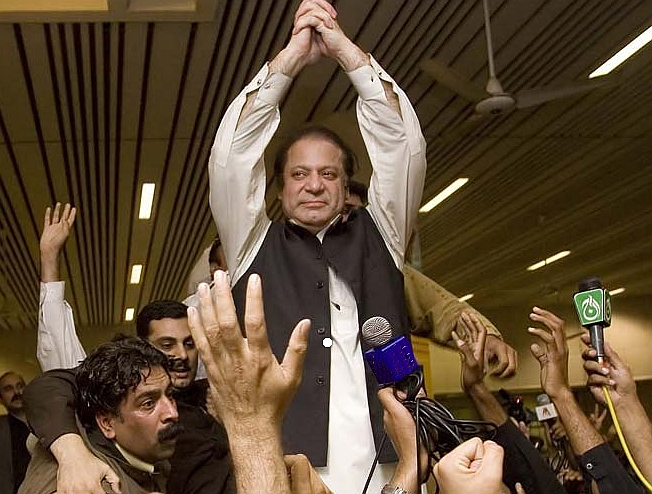
Upon reaching Lahore, Sharif was supposedly greeted by a huge crowd of
supporters. On November 26, 2007, Nawaz Sharif filed for the January
Parliamentary elections. He handed in his papers in Lahore filing for two
parliamentary seats.
Nawaz Sharif with Sakib Berjees at Party convention in The London Hilton on Park Lane, London, in 2007.On December 3, it was announced that Sharif would meet former Pakistani Prime Minister Benazir Bhutto to discuss a possible boycott of the January 8 elections. Mr Sharif had stated that his party, Pakistan Muslim League (N), would not take part in the elections unless the judges sacked under emergency rule were reinstated.
The Election Commission of Pakistan then banned Sharif from taking part in the January 8 elections. A rival candidate complained to the commission citing Sharif's criminal charges. The commission upheld the complaint. Sharif had until Friday to appeal against the ban. An election commissioner Raja Qamaruzaman told Lahore newspapers that His (Nawaz's) nomination papers are rejected because of his convictions. In the case of his opposition rival Benazir Bhutto, President Pervez Musharraf signed into law the amnesty early in 2007 that cleared Ms Bhutto of all corruption charges. However this amnesty did not clear Mr Sharif, having been sentenced to ten years for aeroplane hijacking and terrorism when he attempted to prevent the PIA flight carrying Musharraf and Soomro and a plane full of ordinary passengers in 1999 from landing at Karachi.
On December 6, Mr Sharif attempted to meet former chief justice Iftikhar Chaudhry but was stopped by police. Mr Chaudhry was forced to leave office after refusing to swear allegiance to President Musharraf and also the authorities are preventing him from leaving his household. Sharif told the crowd that he had come to show support for the judges and will not rest until they were restored. Coming off the heels of meeting with former Pakistani Prime Minister Benazir Bhutto both opposition parties were in the process of negotiating what they called a charter of demands which they wanted fulfilled if they were to take part in the January 8 elections. Mr Sharif wanted the re-instatement of the judges before the election takes place to be on the opposition's joint demands. However Benazir Bhutto claimed that this is an issue that parliament could address once the elections have been fought.
On December 7, it was confirmed by Nawaz Sharif that he would not appeal against the ban that was placed on him on December 3, and would not participate as a candidate in the January 8 elections. If Sharif appealed against the ban the matter would have been taken to the Pakistan High Court. Sharif said that he does not recognize this as legitimate because the judges were forced under the rule of President Musharraf. Sharif wrote to the Election Commission saying that he was being prevented from standing for political reasons.
Nawaz Sharif announced on December 10 that he would indeed participate in the January 8 elections. The PML(N) made this decision after he failed to make a decision with opposition rival Benazir Bhutto and her Pakistan Peoples Party (PPP); the two sides complained that elections would not be free and fair under emergency rule placed by President Musharraf on November 3, 2007. Mr Musharraf announced that emergency would end on December 15, a day earlier than planned. Mr Sharif's party would participate in the elections after 33 opposition parties including Ms Bhutto's PPP failed to reach a joint agreement. Mr Sharif announced his party's manifesto being a single demand for the restoration of the judges sacked in November by President Musharraf. Ms Bhutto however said that this is an issue that the new parliament can decide on.
On February 16, 2008 the initial last day of campaigning for Pakistan's political parties, Nawaz Sharif's PML(N) campaigned closely with assassinated former Pakistani Prime Minister Benazir Bhutto's PPP and her widower Asif Ali Zardari.
Assassination of Benazir Bhutto
On December 27, in a CNN interview just hours after the assassination of former
Pakistan Prime Minister Benazir Bhutto, Sharif said:
“ It is not a sad day, it is a dark, darkest, gloomiest day in the history of this country.”
Amidst the shock of the death of former Pakistani Prime Minister Benazir Bhutto, Sharif had announced that he would boycott the soon-to-be-delayed January 8, 2008 Pakistani general elections. Sharif called for President Pervez Musharraf to resign due to the lack of security leading up to Benazir Bhutto's death. Sharif rushed to the hospital where Bhutto was taken to and comforted her supporters and sat next to her body. Sharif called Bhutto his sister and vowed to avenge her death.
A few hours before the murder of Benazir Bhutto, four of Sharif's party workers had been shot dead at Karal Chowk in an attack on a procession to meet him. Gunmen were unidentified. Nawaz Sharif accused Musharraf supporters of the Pakistan Muslim League (Q) (PML(Q)) of the killings.
Pakistani General Elections 2008
However after the death of Bhutto, Sharif met with Zardari and advised him to
boycott elections. Asif Zardari refused the offer and offered Nawaz to take part
in the elections arguing that the opposition parties would definitely win after
this chain of unfortunate events in the country and mishandling of issues by the
government. Nawaz accepted the offer and announced it publicly in a press
conference. He gave the reason that in order to bring the President's government
down the whole opposition must assemble and move in one direction.
On Monday, February 18 the PML (N) dominated the Punjab assembly and won 68 seats out of 272 from the National Assembly finishing second, directly behind the PPP (Bhutto/Zardari's party) at 88. However, after adding the reserved seats for women and minorities, total number rose to 91. The results became clear on February 19. His massive victory in Punjab was met by a festive mood. Later that day in a press conference he said that he would welcome the political leaders back to the parent party who had left his party and joined the PML (Q). Former Pakistani Prime Minister Nawaz Sharif and Asif Ali Zardari, the husband of slain former Prime Minister Benazir Bhutto told February 21, 2008 their parties will work together in the national parliament after scoring big wins in the 2008 election.
On Tuesday, February 26, 2008, Nawaz announced that he and his brother Shabaz
Sharif would run in by-elections upcoming in the country within the next few
weeks, to become Members of Parliament, since they have no restrictions against
them. the PML (N) left it to the PPP to chose a Prime Minister, since they
agreed on forming a coalition government.
Nawaz Sharif has challenged the petition filed by the federal government against
the acceptance of Mr Sharif’s candidature for National Assembly seat-121. Ashtar Ausaf Ali, former Advocate General of Punjab, is the lawyer representing
Nawaz Sharif.
The Pakistan Muslim League-Nawaz (PML-N) and the Pakistan Peoples Party (PPP) on June 27, 2008, won 3 and 2 by-election seats, respectively, to the national parliament. Polls were postponed for the 6th seat in Lahore due to Nawaz Sharif's eligibility contest. A court ruled he was ineligible due to the old conviction, amid the government appeal in the Supreme Court, which will hear the case on June 30, thus postponing the vote in the constituency. The 2 parties also won 19 of 23 provincial assembly seats where by-elections were held. The results will not affect the February 18 general election results in which Benazir Bhutto's PPP won 123 seats in the 342-seat National Assembly and Sharif's party came second with 91, while Pervez Musharraf's party came a poor third with 54 seats. Sharif's Pakistan Muslim League (Nawaz) won 8 provincial assembly seats, while the PPP won 7 provincial seats.
Reinstatement of Judges
Nawaz Sharif stated in Lahore that: "I want to inform the entire nation that on
Monday 12 May 2008, all deposed judges will be restored; the national assembly
will approve a resolution the same day." The judges include Iftikhar Chaudhry,
Supreme Court Chief Justice, and President Musharraf sacked 60 judges under the
state of emergency. On 12 May 2008 the day that PML-N leader Nawaz Sharif stated
that the deposed judges sacked under President Musharraf's emergency rule last
November, would be reinstated, Mr Sharif over the weekend beginning 9th - 11th
May met PPP Partner Asif Ali Zardari in London to discuss, the deadlock and the
official date of when the judges would be reinstated, but the meetings
dissolved, with no agreement that both party officials could agree upon.
Returning to Islamabad Nawaz spoke to media mogul Geo Television Network and
announced that he is withdrawing his party members from the federal government
and effectively resigning from the coalition government.
Resignations of the Coalition Government
On May 12th, PML (N) announced it was leaving the Government after failure of
the Government to reinstate the Judges. Its ministers resigned. Although, PPP is
still hopeful that PML (n) will be back to Government once the Judges Issue is
resolved.
2008 Musharraf impeachment
On August 7, 2008, the Pakistan Peoples Party and the Pakistan Muslim League (N)
agreed to force Musharraf to step down and begin his impeachment. Asif Ali
Zardari and Nawaz Sharif, announced sending a formal request or joint charge
sheet that he steps down, and impeach him through parliamentary process upon
refusal. Musharraf, however, said: “I will defeat those who try to push me to
the wall. If they use their right to oust me, I have the right to defend
myself."[27] Pervez Musharraf, accordingly delayed his departure for the Beijing
Olympics, by a day.[28] A senior coalition official told Reuters: "Yes, we have
agreed in principle to impeach him."[29] The draft of the ruling coalition’s
joint statement had been finalized by the draft Committee, and Musharraf must
obtain vote of confidence from the National Assembly and 4 provincial
assemblies.[30] The government summoned the national assembly, or lower house of
parliament, to sit on August 11.[31] Capt. Wasif Syed, spokesman for the
Pakistan People's Party -- confirmed: "A decision has been made that he has to
go now, and all the parties have agreed on this point.".
On 18th August 2008, Musharraf resigned as President of Pakistan. He said he was resigning for the country.
Presidential election
Pakistan's Election Commission on August 22 announced that Presidential
elections would be held on September 6, and the nomination papers could be filed
from August 26.[33] The president is elected by the 2 houses of parliament and
the 4 provincial assemblies.[34]. There was speculation that Nawaz Sharif would
run for President, but on August 25, 2008, Nawaz Sharif announced that
Saeeduzzaman Siddiqui would be the Pakistan Muslim League (N) nominee to replace
Pervez Musharraf as President of Pakistan[35]. Siddiqui was defeated by Asif Ali
Zardari for the presidency
2013 Elections
The elections were held on 11th May 2013 after the government of PPP completed
it tenure, a historic election which was supposed to be free and fair (Many
people have reservations) the PML of Nawaz Sharief with its partners got clear
mejority in the National Assembly and Mr. Nawaz Sharief was elected as the prime
minister on 5th June 2013.

Advertisement
Advertise on this site click for advertising rates