
 Pakistan -
Peshawar
Pakistan -
Peshawar
Peshawar is the most lively city of Pakistan. It is the heart of the North western (Khyber Pakhtoon Kuwah) province. The city lies at the edge of the Historic Khyber pass. The city is well known for its historic and cultural values. Peshawar has seen many invaders and travelers passing it by, from around the world. (history page) There are a number of things to do & Visit in Peshawar. Being an important border city the bazaars of Peshawar are the most attractive. There is always a lot of activity going on. The Kissa Khawani Bazaar (Story tellers Bazaar) is the most interesting of all. There are merchandise from all over central Asia here. Oriental Rugs , Afghan Jewelry , tribal Handicrafts, Wood carving , spices and all kinds of fabrics are available in the city.
Peshawar Tours
- Full Day Peshawar Tour from Islamabad
- Khyber Pass Tour from Peshawar (restricted access)
- Qissa Khawani Bazaar Walking Tour
Peshawar derives its name from a Sanskrit word "Pushpapura" meaning the city of flowers. Peshawar’s flowers were mentioned even in Moghal Emperor Babur’s memoirs.
Alexander?s legions and the southern wing of his army were held up here in 327 B.C. for forty days at a fort excavated recently, 27 kms north-east of Peshawar at Pushkalavati (lotus city) near Charsadda.
The great Babur marched through historic Khyber Pass to conquer South Asia in 1526 and set up the Moghal Empire in the South Asia.
The pass and the valley have resounded to the tramp of marching feet as successive armies hurtled down the crossroad of history, pathway of commerce, migration and invasion by Aryans, Scythians, Persians, Greeks, Bactrians, Kushans, Huns, Turks’ Mongols and Moghals.
Peshawar the Frontier town:
And Peshawar is now, as always, very much a frontier town. The formalities of dress and manner give way here to a free and easy style, as men encounter men with a firm hand-clasp and a straight but friendly look. Hefty handsome men in baggy trousers and long, loose shirts, wear bullet studded bandoleers across their chests or pistols at their sides as a normal part of their dress.
There is just that little touch of excitement and drama in the air that makes for a frontier land. An occasional salvo of gun fire-no, not a tribal raid or a skirmish in the streets but a lively part of wedding celebrations.
The Land of Pathans
Remember, we are in the land of the Pathans - a completely male-dominated society. North and south of Peshawar spreads the vast tribal area where lives the biggest tribal society in the world, and the most well known, though much misrepresented.
Pathans are faithful Muslims. Their typical martial and religious character has been moulded by their heroes, like Khushal Khan Khattak, the warrior poet and Rehman Baba, a preacher and also a poet of Pushto language.
Today, they themselves guard the Pakistan-Afghanistan border along the great passes of the Khyber, the Tochi, the Gomal and others on Pakistan’s territory, but before independence they successfully defied mighty empires, like the British and the Moghal and others before them, keeping the border simmering with commotion, and the flame of freedom proudly burning.
Peshawar is the great Pathan city. And what a city ! Hoary with age and the passage of twenty-five centuries, redolent with the smell of luscious fruit and roasted meat and tobacco
Peshawar Transfers and getting there
Peshawar airport is only 10 minutes drive from downtown hotels. You can get a car from the airport or have us book a transfer for you. Peshawar is 170 kilometers from Islamabad Capital of Pakistan. It takes about 3 hours for a straight drive from Islamabad to Peshawar. However if you chose to visit Taxila oldest buddhit capital of gandhara, it will take 5 - 6 hours.
You can also drive to or from Swat to Peshawar about 190 kilometers which is a green valley in the foothills of hindukush mountains.
Peshawar Tours
4 Hours Peshawar Tour
Pick up from your hotel at 8AM drive to Khyber bazaar, then take a walk thru Khyber bazaar ro Kissa Khawani bazaar, Meena Bazaar, Sarafa bazaar and walk to Mohabat Khan mosque later meet your car behind the Balahisar fort and drive to Peshawar museum visit the museum in detail and return to Hotel.
6 Hours Peshawar Tour
Pick up from your hotel at 8AM drive to Khyber bazaar, then take a walk thru Khyber bazaar ro Kissa Khawani bazaar, Meena Bazaar, Sarafa bazaar and walk to Mohabat Khan mosque later meet your car behind the Balahisar fort and drive to Peshawar museum visit the museum in detail later continue to Islamia college to see this magnificent building and drive to the last point where foreigners can go near the Khyber pass and return to Hotel.
: There are 2 major tour options in the peshawar city. Half day peshawar city tour. You wll visit Kissa khawani bazaar Khyber bazaar Sarafa bazaar All of them present a very rich cultural scene you get to see a hustle bustle of different races which inhabit this historic city. Also visit the Mohabat khan mosque & Peshawar museum
Important Landmarks of Peshawar
The Old City
Until the mid-fifties Peshawar was enclosed within a city wall and sixteen gates. Of the old city gates the most famous was the Kabuli Gate but only the name remains now. It leads out to the Khyber and on to Kabul.
You come across two-and -three story houses built mostly of unbaked bricks set in wooden frames to guard against earthquakes, Many old houses have beautifully carved heavy wooden doors and almost all have highly ornamental wooden balconies. There is a tall and broad structure whose lofty portal look down upon the street. This historical building houses the police offices and the site was occupied centuries ago by a Buddhist stupa, then by a Hindu temple and then by a Moghal sarai. It was, in Sikh days, the seat of General Avitable, an Italian soldier of fortune in the service of Ranjit Singh.
Qikkas (Kissa) Khawani Bazaar
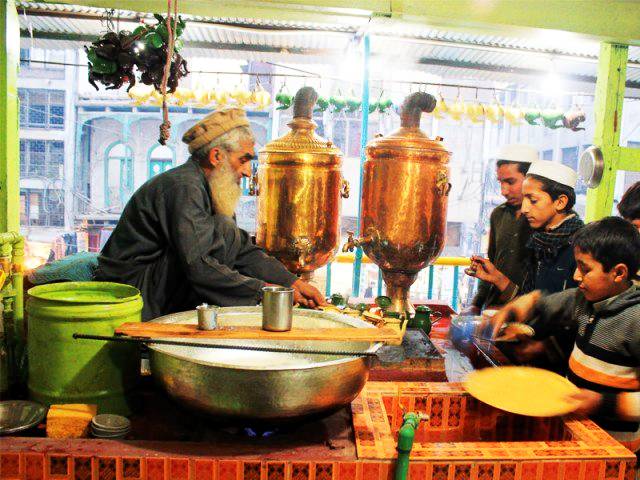
Here perhaps visiting travelers or the relaxing townsmen were regaled with stories by professional story tellers, in the evening, in the many teashops that still adorn the bazaar front with their large brass samovars and numerous hanging teapots and teacups.
As in most eastern bazaars, the shops of delicacies predominate, and here too you will find many colorful fruit shops displaying the glorious harvest of Peshawar's unrivaled bread and justly celebrated "Kababs" and "Tikkas" meat sizzling on hot coals, in the many wayside cafes.
Leather goods shops are the next most numerous, selling that wonderful footwear, the Peshawari "Chappals" or sandals, belts, holsters and bandoliers and a special variety of light but sturdy suitcase called "Yakhdaan".
Other Bazaars
As you move up, the Qissa Khawani Bazaar turns left and here begins the bazaar of coppersmiths whose jewel-like engraved and embossed jars, bowls, ewers and plates are piled up in shops like glistening treasure trove. Other famous bazaars of Peshawar are the Khyber Bazaar. Bird Bazaar and Meena Bazaar, Jewellery Bazaar and Mochilara (Shoe Makers' Bazaar).
In fact, the variety of craft in which Peshawar excels even today is amazing and this is a part of the city's character often eclipsed by its martial tradition. Remember that it was in this valley of Peshawar that there flourished that remarkable school of Ghandhara sculpture, which is one of the glories of Pakistan's heritage.
Chowk Yadgar
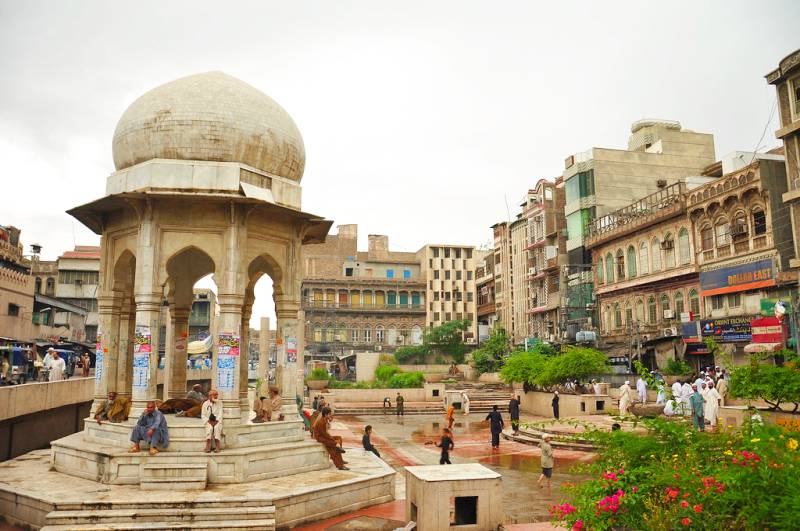
Soon you reach the central square called chowk Yadgaar the traditional site of political rallies. The two routes from the old city meet here. Parking of cars can safely be done only at this place in the old city.
Mohabat Khan Mosque
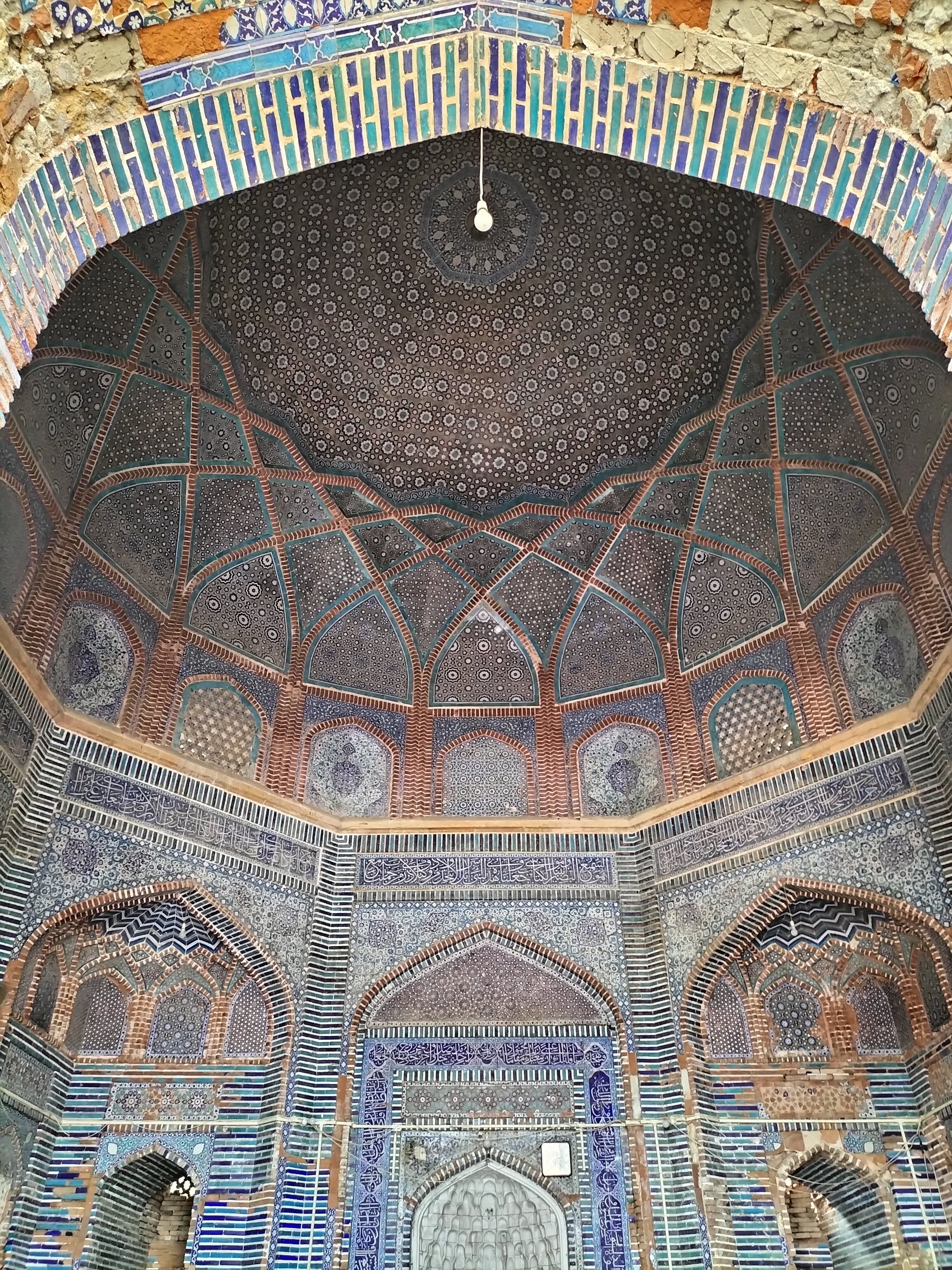
The only significant remaining Moghal mosque in Peshawar was built by Mohabat khan in 1670 A.D. when he was twice Governor of Peshawar under Moghal Emperors Shah Jehan and Aurangzeb. The mosque was nearly destroyed by fire in 1898 A.D. and was only saved by the unremitting efforts of the faithful. The extensive renovation of the mosque was done by the traditional craftsman. The mosque is a fine specimen of Moghal architecture of Emperor Shah Jehan's period. The interior of the prayer chamber has been lavishly decorated with floral work and calligraphy.
Bala Hisar fort
The mighty Bala Hisaar Fort lies on both eastern approaches to Peshawar city. It meets the eye when coming from Rawalpindi or from the Khyber. It is a massive frowning structure as its name implies, and the newcomer passing under the shadow of its huge battlements and ramparts cannot fail to be impressed. Originally built by Babar, the first of the Moghals in 1526-30, it was rebuilt in its present form by the Sikh Governor of Peshawar, Hari Singh Nalva, in the 1830's under the guidance of French engineers. It houses government offices at present.
Peshawar Museum
Peshawar Museum is housed in an imposing building of the British days. It was formerly the Victoria Memorial Hall built in 1905. The large hall, side galleries and the raised platform which were used for ball dances now display in chronological order finest specimens of Gandhara sculptures, tribal life, the Muslim period and ethnography.
Sethi Houses
These houses are situated in Mohallah Sethian and can be approached from Chowk yadgaar. These are highly decorated style of building with carved wooden doors, partitions, balconies, mirrored and painted rooms. The Sehtis are the traditional business community of Peshawar. The main house was built in 1882 AD. by Haji Ahmed Gul who migrated from Chamkani (a near village) almost 6 generations ago.
New Peshawar
Across the railway line was built the new modern Peshawar, the Cantonment, like the ones which the British built near every major city for their administrative offices, military barracks, residences, parks, churches and shops.
The Peshawar "Sadder" (Cantonment) is a spaciously laid out neat and clean township with avenues of tall trees, wide tarred roads, large single storied houses with lawns and a pervading scent of rare shrubs and flowers that is Peshawar's own.
The heart of the sadder is the Khalid bin Walid (Company) Bagh which is an old Moghal Garden. Its huge ancient trees and gorgeous big roses are a sight to remember. Two other splendid old gardens are the Shahi Bagh in the north-east and the Wazir Bagh in the south-east, all of which give the character of a garden city to Peshawar.
In Sadder, there are the splendid modern state bank building, Governor's house, hotels, old missionary Edwards collage ,archly stocked museum, fine shopping area and right in the middle is the tourist Information center at Dean's hotel (Phone:279781).
The Peshawar of the hoary past is the old city, the Peshawar of the British period (1849 to 1947) is the Cantonment but the Peshawar of independent Pakistan is the vast extension of the city west and east.
Westward, on the road to the Khyber, where in the days gone by, no one was safe from tribal raids, today stretches a long line of educational and research institutions, such as the Academy of rural development, the teachers training college, the north regional laboratories of the council of scientific and industrial research and many others.
But the pride of Peshawar today is its university, a vast sprawling garden town of red brick buildings and velvet lawns, which comprises a dozen departments and colleges of law, medicine, engineering and forestry. Special mention must be made of the Islamia college, which was the pioneer national institution that ignited the torch of enlightenment in this region,67 years ago.
The road stretching out east towards Rawalpindi is lined for miles upon miles with factories producing a variety of goods and also orchard producing some of the world's finest plums, pears
and peaches. Rice, sugar-cane and tobacco are the rich cash-crops of the well-watered Peshawar valley through which flows the Kabul River and at the end of which the mighty Indus forms the district boundary for 48 1/2 Kms (30miles),the two joining near the historic Attock fort.
Other Places in Peshawar
- Peshawar Museum – Gandhara art and Buddhist artifacts.
- Mohabbat Khan Mosque – Classic Mughal architecture.
- Kissa Khawani Bazaar The cultural bazaar open since 400 year
- Khyber Gate – Entrance to the legendary Khyber Pass.
Peshawar Hotels
Pearl Continental Hotel Peshawar now destroyed due to bomb blast.
More hotels in Peshawar.
Celebrities and Artists from Peshawar
Travel & Culture Services Pakistan
Online Hotel Booking
| Home | Pakistan Tours
| Conferences & Incentives | Hotels | Islamabad | Karachi | Lahore | Peshawar| Quetta | Multan | Hyderabad | Hunza
| Gilgit | Chitral | Swat | Karakorum Highway | History | Archeology | Weather | Security | Contact Information |

Advertisement
Advertise on this site click for advertising rates