
Pakistan -
Sheikhupura
A land of Greatest Mountains & Colorful Culture - A Complete Guide to
Pakistan
 Basic Info History of Pakistan Climate
Places to Visit Slide Show Search
Tours
Basic Info History of Pakistan Climate
Places to Visit Slide Show Search
Tours
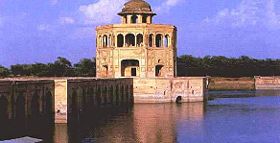
Sheikhupura or (Shekhupura, Shekhu Pura) (Urdu: شيخوپورہ) is an industrial city in the Punjab province of Pakistan located northwest of metropolis of Lahore. It is known for its historical places, and is commonly known locally as "Qila (fort) Shaikhupura, because of the fort in the city, constructed by the Mughal Emperor Jahangir. Sheikhupura is a day Excursion from Lahore. Famous Hiran Minar is located here.
History
 The
history of Sheikhupura goes back to 1000 BC. Historical research has established
the fact that Sangla or Sakala was the capital of Punjab once, and it was here
that Alexander the Great of Macedonia (Sikandar e azam) in 325BC fought one of
his most serious battles of his career. Its name is spoken of, firstly in the
pages of Tuzk-e-Jahangiri as Jahangirpura, after the name of Prince Salim Nur u
ddin muhammad Jahangir.
The
history of Sheikhupura goes back to 1000 BC. Historical research has established
the fact that Sangla or Sakala was the capital of Punjab once, and it was here
that Alexander the Great of Macedonia (Sikandar e azam) in 325BC fought one of
his most serious battles of his career. Its name is spoken of, firstly in the
pages of Tuzk-e-Jahangiri as Jahangirpura, after the name of Prince Salim Nur u
ddin muhammad Jahangir.
Mughal Emperor Nor-u-Din Muhammad Jahangir laid the foundation of historical Sheikhupura. In 1607, Sheikhupura was constructed following an order of Empror Jahangir. The father of Jahangir, Emperor Jalal-uddin Mohammad Akbar used to call him Sheikhu (a nick name). Hence during Sikh rule (1818) the new city was named Sheikhupura,
During the reign of Emperor Jahangir (1605 to 1627),
Sheikhupura had the status of royal hunting ground. In Tuzke-Jahangiri, Empror
Jahangir wrote during the events in 1607:
“ On the day of Tuesday, I reside in Jahangirpura, my hunting ground. According
to my order, a Minar and a grave for my deer, Mansraj, were constructed here. ”
Mughal Emperor Jahangir granted the estate of
Sheikhupura to Syed Usman, the father of Shah Bilal, a religious preceptor of
the line of Qadiriyyah.
Over the whole district, the period between the decline of Mughal Empire after
the death of Mughal Emperor Aurangzeb and the rise of Sikh confederacies was one
of utter confusion and anarchy. The successive shocks of invasion from the
northwest, and the devastation caused again and again by the invading armies of
Nadir Shah.
Nadir Shah and Ahmad Shah Abdali (from Afghanistan) (1724-1773) almost
completely ruined the prosperity of the tract. After the death of Aurangazeb,
Muslim power was broken by the Sikhs who ruled through various misls or small to
medium sized groups. Nadir Shah and Ahmad Shah Abdali led raids that further
weakened local Muslim rule. Several raids were made by the Bhangi Sardars, a
Sikh community that laid to waste many Mosques and Madrasas. Finally around
1780, Ranjit Singh, a sikh ruler defeated the grandson of Ahmad Shah Abdali and
later captured this district. The sikhs were routed by the British around 1850
and it stayed under British rule till independence in 1947.
In 1851, Tehsil Sheikhupura worked under Gujranwala. The Artimapal Secretary Chief Commissioner Lahore wrote a letter to the Department of Wealth in 1855 to combine the Tehsil Sheikhupura with the District Lahore but it was never done. As soon as it became a DistrictZillah, a lot of lawyers came to practice. Under of Sir Gungha Ram, district courts and hospitals were constructed in the city.
Hiran Minar
Hiran Minar or (Minate of Deer) is situated in Sheikhupura, Pakistan. It was constructed by Emperor Jehangir as a monument to Mansraj, one of his pet deers.
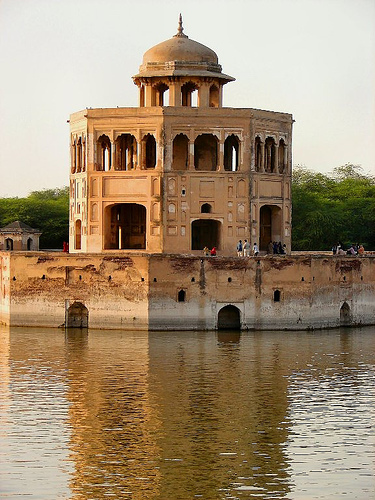 The
structure consists of a large, almost-square water tank with an octagonal
pavilion in its center, built during the reign of Mughal emperor Shah Jahan; a
causeway with its own gateway connects the pavilion with the mainland and a
100-foot-high minar, or minaret.
The
structure consists of a large, almost-square water tank with an octagonal
pavilion in its center, built during the reign of Mughal emperor Shah Jahan; a
causeway with its own gateway connects the pavilion with the mainland and a
100-foot-high minar, or minaret.
At the center of each side of the tank, a brick ramp slopes down to the water, providing access for royal animals and wild game. The minar itself was built by Emperor Jahangir in 1606 to honor the memory of a pet hunting antelope named Mansraj.
Unique features of this particular complex are the antelope's grave and the distinctive water collection system. At each corner of the tank (approximately 750 by 895 feet in size), is a small, square building and a subsurface water collection system which supplied the tank; only one of these water systems is extensively exposed today.
Another special feature of Hiran Minar is its location and environment: the top of the minar is perhaps the best place in the province of Punjab to get a feel for the broader landscape and its relationship to a Mughal site
Looking north from the top of the minar, one can see a
patch of forest which is similar to the scrub forest vegetation of Mughal times,
while to the west are extensively-irrigated fields, a product of the late
nineteenth and early twentieth centuries, but similar in size and appearance to
the well-irrigated fields of the Mughal period.
Travel & Culture Services Pakistan
220A Panorama center Fatima Jinnah Road KarachiEmail : Click Here To contact us.
| Home | Pakistan Tours | Conferences & Incentives | Hotels | Airfares | Islamabad | Karachi | Lahore | Peshawar | Quetta |
| Sibi | Faisalabad | Multan | Hyderabad | Sukkur | Hunza | Gilgit | Baltistan | Chitral | Swat | Karakorum Highway |
History of Pakistan | Archeology | Weather | Security | Contact Information |

Advertisement
Advertise on this site click for advertising rates