
Zulfikar Ali Bhutto
"My country hearkens for me, why should I waste my time here in the Security Council?" (United Nations, New York City, December 15, 1971)
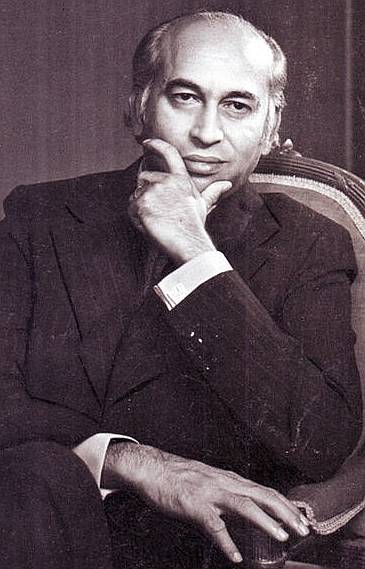 Zulfiqar Ali Bhutto was born on January 5, 1928. He was the only son of Sir Shah Nawaz
Bhutto. Zulfiqar Ali Bhutto completed his early education from Bombay's Cathedral High
School. In 1947, he joined the University of Southern California, and later the University
of California at Berkeley in June 1949. After completing his degree with honors in
Political Science at Berkeley in June 1950, he was admitted to Oxford.
Zulfiqar Ali Bhutto was born on January 5, 1928. He was the only son of Sir Shah Nawaz
Bhutto. Zulfiqar Ali Bhutto completed his early education from Bombay's Cathedral High
School. In 1947, he joined the University of Southern California, and later the University
of California at Berkeley in June 1949. After completing his degree with honors in
Political Science at Berkeley in June 1950, he was admitted to Oxford.
Zulfiqar Ali Bhutto married Nusrat Isphahani on September 8, 1951. He was called to Bar at Lincoln's Inn in 1953, and the same year his first child, Benazir Bhutto, was born on June 21. On his return to Pakistan, Bhutto started practicing Law at Dingomal's.
In 1958, he joined President Iskander Mirza's Cabinet as Commerce Minister. He was the youngest Minister in Ayub Khans Cabinet. In 1963, he took over the post of Foreign Minister from Muhammad Ali Bogra.
His first major achievement was to conclude the Sino-Pakistan boundary agreement on March 2, 1963. In mid 1964, Bhutto helped convince Ayub of the wisdom of establishing closer economic and diplomatic links with Turkey and Iran. The trio later on formed the R. C. D. In June 1966, Bhutto left Ayub's Cabinet over differences concerning the Tashkent Agreement.
Zulfiqar Ali Bhutto launched Pakistan Peoples Party after leaving Ayub's Cabinet. In the general elections held in December 1970, P. P. P. won a large majority in West Pakistan but failed to reach an agreement with Sheikh Mujib-ur-Rahman, the majority winner from East Pakistan. Following the 1971 War and the separation of East Pakistan, Yahya Khan resigned and Bhutto took over as President and Chief Martial Law Administrator on December 20, 1971.
After Pakistan parliamentary elections gave an East Pakistani separatist party an overall majority in December of 1970, Zulfikar Ali Bhutto, the elected leader of West Pakistan, refused demands for greater autonomy in the east. In March of 1971, East Pakistan's leaders proclaimed the independent state of Bangladesh and West Pakistani forces were called in to suppress the revolt. In the ensuing civil war, an estimated one million Bengalis the largest ethnic group in Bangladesh were killed by the West Pakistani troops, while over ten million more took refuge in India. On December 3, 1971, India, which had provided substantial clandestine aid to the Bangladesh independence movement, launched a massive offensive against West Pakistan. Bhutto traveled to New York City to plead West Pakistan's case before the United Nations, but left in disgust when the Security Council supported Bangladesh's independence and called for a cease-fire. On December 17, 1971, 90,000 West Pakistani troops surrendered to Indian forces in Bangladesh and the war came to an end. Bhutto subsequently became prime minister of Pakistan, and in February of 1974, he formally recognized the independence of Bangladesh.
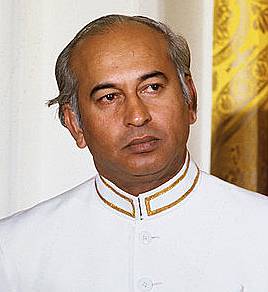 In early 1972, Bhutto nationalized ten categories of major industries, and withdrew
Pakistan from the Commonwealth of Nations and S. E. A. T. O. when Britain and other
western countries recognized the new state of Bangladesh. On March 1, he introduced land
reforms, and on July 2, 1972, signed the Simla Agreement with India, which paved the way
for the return of occupied lands and the release of Pakistani prisoners captured in East
Pakistan in the 1971 war.
In early 1972, Bhutto nationalized ten categories of major industries, and withdrew
Pakistan from the Commonwealth of Nations and S. E. A. T. O. when Britain and other
western countries recognized the new state of Bangladesh. On March 1, he introduced land
reforms, and on July 2, 1972, signed the Simla Agreement with India, which paved the way
for the return of occupied lands and the release of Pakistani prisoners captured in East
Pakistan in the 1971 war.
After the National Assembly passed the 1973 Constitution, Bhutto was sworn-in as the Prime Minister of the country.
On December 30, 1973, Bhutto laid the foundation of Pakistan's first steel mill at Pipri, near Karachi. On January 1, 1974, Bhutto nationalized all banks. On February 22, 1974, the second Islamic Summit was inaugurated in Lahore. Heads of States of most of the 38 Islamic countries attended the Summit.
Following a political crisis in the country, Bhutto was imprisoned by General Zia-ul-Haq, who imposed Martial Law on July 5, 1977.
On April 4, 1979, the former Prime Minister was hanged, after the Supreme Court upheld the death sentence passed by the Lahore High Court. The High Court had given him the death sentence on charges of murder of the father of a dissident P. P. P. politician.
Zulfiqar Ali Bhutto was buried in his ancestral village at Garhi Khuda Baksh, next to his father's grave.
Bhutto, Zulfikar Ali (1928-1979), president and prime minister of Pakistan from 1971 to 1977. Bhutto was a charismatic leader who charted a foreign policy of nonaligned neutrality for Pakistan in the 1960s and 1970s. He was ousted from power in a military coup and subsequently convicted of murder and executed.
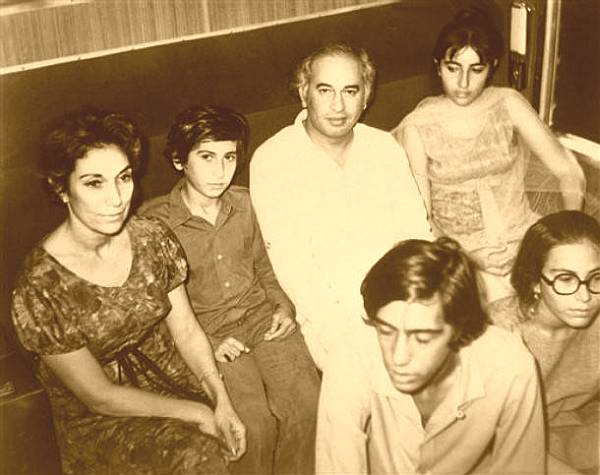
Bhutto was born near Larkana, in Sind Province (then part of British India; part of Pakistan since 1947). He was descended from a long-established family of Muslim landlords and politicians. His father, Shah Nawaz Bhutto, became a major figure in Indian colonial politics, receiving knighthood for his work with the British government on issues of Indian self-rule.
Bhutto grew up in Bombay (now Mumbai), receiving his secondary education at the elite Doon School. At age 13 he was married to his cousin, an heiress. As a student, Bhutto met Mohammed Ali Jinnah, the future founding father of Pakistan, and participated in the movement to partition India in order to create Pakistan as an independent state for Indian Muslims.
Bhutto attended the University of Southern California in Los Angeles from 1947 to 1949 and received a bachelor of arts degree from the University of California at Berkeley in 1950. He then studied law at the University of Oxford, in England, earning a master of arts degree in 1953. In 1951, while still a student, Bhutto married Begum Nusrat Ispahani of Karachi, with whom he had four children. (Bhutto had had no children with his first wife.) After finishing his studies, Bhutto returned to Pakistan, which had won its independence in 1947, and set up a successful legal practice in Karachi.
Bhutto had his first major political experience as a member of a delegation to the United Nations (UN), where he addressed the General Assembly in 1957 on India-Pakistan relations. He also chaired the Pakistan delegation to the first UN Conference on the Law of the Sea, held in Geneva, Switzerland, in March 1958.
In October 1958 General Muhammad Ayub Khan, commander in chief of Pakistan’s armed forces, took control of Pakistan’s government, imposing martial law and declaring himself president. Bhutto assumed positions of increasing responsibility in Ayub Khan’s government, culminating in his appointment as foreign minister in 1963. Bhutto restructured Pakistan’s political commitments to rely less heavily on the West and instead achieve a nonaligned neutrality (see Nonaligned Movement). As part of this policy, he forged closer ties with China. Bhutto pursued a strident anti-India campaign over the disputed territory of Kashmir, encouraging Ayub Khan to invade the region (see Jammu and Kashmir). A 1965 war with India over Kashmir ended with no gains for Pakistan and humiliated Ayub Khan's government. Nevertheless, Bhutto did not moderate his anti-India stance, even after Ayub Khan signed a peace agreement with India in January 1966. Bhutto’s fiery speeches made him a well-known and popular figure throughout Pakistan. However, his growing political presence and his critical stance toward the government made his position in Ayub Khan’s administration untenable. In 1966 he resigned from his cabinet post.
From his new position outside the government, Bhutto began to publicly attack Pakistan’s military for mishandling the war. He also criticized the presence of continued restrictions on democratic institutions in Ayub Khan’s government. In 1967 Bhutto formed the Pakistan People's Party (PPP) to oppose Ayub Khan’s regime. He adopted a uniform similar to those worn by China’s Communist Party leaders and called for the introduction of "Islamic socialism" in Pakistan and the commencement of a "thousand year war" against India. Using the title "Leader of the People," Bhutto launched a nationwide tour, agitating against the military dictatorship. He was arrested in connection with these activities in November 1968 and detained for three months. The movement he helped unleash in West Pakistan (coextensive with the country’s current boundaries), in conjunction with agitation for greater autonomy taking place in East Pakistan (now Bangladesh), forced the resignation of Ayub Khan in March 1969.
Ayub Khan handed power over to the army commander in chief, Agha Muhammad Yahya Khan, who assumed the presidency and reimposed martial law. The issue of an autonomous East Pakistan continued to plague Yahya’s administration. In elections held in 1970, the pro-autonomy Awami League won by a landslide in East Pakistan, capturing enough parliamentary seats to control any government that might be formed. Bhutto’s PPP captured the majority of seats in West Pakistan. When Yahya and the PPP delayed the transfer of power to the newly elected representatives in March 1971, public unrest erupted in East Pakistan. East Pakistani leaders demanded the establishment of an independent nation of Bangladesh, and the Pakistani army cracked down brutally on civilians as well as on armed revolutionaries in East Pakistan. When India intervened in the civil war in December, the Pakistani army was swiftly defeated, and East Pakistan emerged as the state of Bangladesh. Yahya Khan resigned, and Bhutto was inaugurated as president and chief martial law administrator on December 20, 1971.
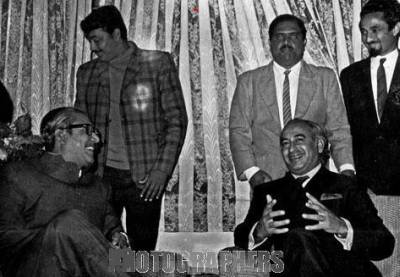 In office, Bhutto introduced socialist economic reforms
while working to prevent any further division of the country. He nationalized
Pakistan’s major industries, life insurance companies, and private schools and
colleges. Although still a major landholder, dubbed by his opponents the "Raja of
Larkana," Bhutto enacted tax relief for the country’s poorest agricultural
workers and placed ceilings on land ownership. He countered secessionist movements in all
of Pakistan's provinces, lifted martial law in 1972, and pushed through a new constitution
in 1973 that recognized Islam as the national religion. Under the parliamentary system
established by the new constitution, Bhutto became prime minister. Bhutto’s support
for democratic processes was uneven. A popular leader, he engaged in meet-the-people tours
that attracted huge crowds. However, he also repressed all disagreement by opposition
parties in Pakistan’s National Assembly.
In office, Bhutto introduced socialist economic reforms
while working to prevent any further division of the country. He nationalized
Pakistan’s major industries, life insurance companies, and private schools and
colleges. Although still a major landholder, dubbed by his opponents the "Raja of
Larkana," Bhutto enacted tax relief for the country’s poorest agricultural
workers and placed ceilings on land ownership. He countered secessionist movements in all
of Pakistan's provinces, lifted martial law in 1972, and pushed through a new constitution
in 1973 that recognized Islam as the national religion. Under the parliamentary system
established by the new constitution, Bhutto became prime minister. Bhutto’s support
for democratic processes was uneven. A popular leader, he engaged in meet-the-people tours
that attracted huge crowds. However, he also repressed all disagreement by opposition
parties in Pakistan’s National Assembly.
On the international front, Bhutto resumed implementation of his policy of nonaligned neutrality. He withdrew Pakistan from the British Commonwealth of Nations and from the Southeast Asia Treaty Organization (SEATO), sponsored by the United States. In July 1972 he negotiated the Simla Agreement, which confirmed a line of control dividing Kashmir and prompted the withdrawal of Indian troops from Pakistani territory. To forge closer ties with the Islamic world, in 1974 Bhutto hosted the second meeting of the Organization of Islamic States in the city of Lahore. He used this forum to announce Pakistan’s official recognition of Bangladesh. To bolster Pakistan’s military defense capabilities, Bhutto laid the groundwork for a nuclear weapons program.
During elections held in March 1977, nine opposition parties, united as the Pakistan National Alliance (PNA), ran a popular campaign against Bhutto’s PPP. When the PPP won a decisive victory in the parliamentary round of the elections, the PNA accused Bhutto’s party of rigging the vote and withdrew in protest from upcoming provincial elections. Widespread street fighting broke out, and opposition politicians were arrested.
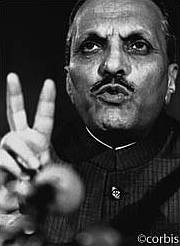 On July 5 the military, led by General Muhammad Zia
ul-Haq, staged a coup. Zia relieved Bhutto of power, holding him in detention for a
month. Upon his release, Bhutto traveled the country amid adulatory crowds of PPP
supporters. In September the army arrested Bhutto again on charges of authorizing the
murder of a political opponent in 1974. Bhutto insisted that the allegations were false,
but the high court in Lahore, packed with Zia's supporters, convicted Bhutto and imposed
the death sentence. The Supreme Court approved the judgment by a 4-3 vote, and despite
international protests, Bhutto was hanged in April 1979.
On July 5 the military, led by General Muhammad Zia
ul-Haq, staged a coup. Zia relieved Bhutto of power, holding him in detention for a
month. Upon his release, Bhutto traveled the country amid adulatory crowds of PPP
supporters. In September the army arrested Bhutto again on charges of authorizing the
murder of a political opponent in 1974. Bhutto insisted that the allegations were false,
but the high court in Lahore, packed with Zia's supporters, convicted Bhutto and imposed
the death sentence. The Supreme Court approved the judgment by a 4-3 vote, and despite
international protests, Bhutto was hanged in April 1979.
The Pakistani population was divided in its opinion of Bhutto. While a significant segment of the population viewed him as a demagogue who deserved his fate, the majority of the population supported Bhutto’s populist and nationalist programs and viewed him as a martyr for democracy. After Zia died in an airplane crash in 1988, elections brought the PPP back to power, led by Bhutto's daughter, Benazir Bhutto.
Bhutto's published works include The Myth of Independence (1969), The Great Tragedy (1971), Bilateralism: New Directions (1976), and If I Am Assassinated (1979). Among the collections of his speeches are Foreign Policy of Pakistan (1964), The Quest for Peace (1966), and Marching Towards Democracy (1972).
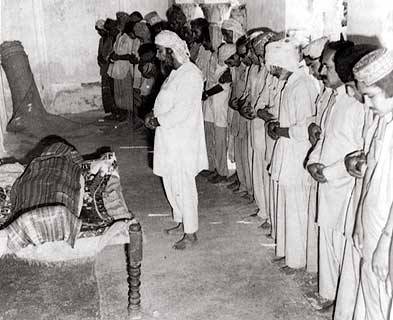 Bhutto's
Death (Hanged / Killed )
Bhutto's
Death (Hanged / Killed )
Gruesome details of Bhutto’s last hours circulated amongst the public. On 5 April 2009 Dawn carried the following description on its front page:
‘[Bhutto] was then told that his cell was about a furlong and half from the gallows, a distance which may be difficult for him to walk, and he should, therefore, lie down in a waiting stretcher to be carried by the jail warders. He protested and said that he would like to walk the distance himself. But he was made to lie down on the stretcher and carried to the gallows by the warder
Before being taken to the gallows he had a ‘tasbih’ in his hand and was turning its beads and reciting something quietly. The ‘tasbih’ had not been seen with him before. It was either hidden in his luggage or handed over to him by Begum Nusrat Bhutto yesterday…. He did not misbehave or talked loudly till the end. He placed his tasbih round his neck when his hands were tied at his back….
Mr Bhutto was handed over to the hangman who tied his legs with a cord, placed the traditional veil on his face and fixed the hanging cord round his neck. His body remained hanging for half an hour.’

Advertisement
Advertise on this site click for advertising rates