[an error occurred while processing this directive]
How to Perform Haj
For Haj 2011 Package Please click here
| Haj & Umrah Policy 2011
How to perform Umrah |
How to perform Haj |
Glossary of Haj & Umrah
How to Perform the Rituals of Hajj and Umrah
by Shaikh Muhammad As-Salih Al-Uthaimeen
In The Name of Allah, Most Gracious, Most Merciful
The Hajj
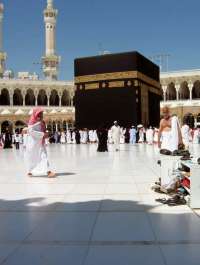 In the forenoon of the eighth day of Dhul-Hijja, a
pilgrim purifies
himself once again by bathing as he did before Umrah in the place in which
he is staying, if convenient. He puts on his Ihram and says: " Here I am for
Hajj. Here I am, oh Allah, here I am. Here I am. You have no partner.
Here I am. Surely all praise, grace and dominion is yours, and you have no
partners."
If he fears that something will prevent him from
completing his Hajj
he should make a condition when he makes his
intentions, saying: " If I am
prevented by any obstacle my place is wherever I am held up." If he has no
such fear, he doesn't make this condition.
A pilgrim goes to Mina and there prays Dhuhr, Asr,
Magrib, Isha
and Fajr, shortening his four unit prayers so as to
make them two units
each, without combining them.
In the forenoon of the eighth day of Dhul-Hijja, a
pilgrim purifies
himself once again by bathing as he did before Umrah in the place in which
he is staying, if convenient. He puts on his Ihram and says: " Here I am for
Hajj. Here I am, oh Allah, here I am. Here I am. You have no partner.
Here I am. Surely all praise, grace and dominion is yours, and you have no
partners."
If he fears that something will prevent him from
completing his Hajj
he should make a condition when he makes his
intentions, saying: " If I am
prevented by any obstacle my place is wherever I am held up." If he has no
such fear, he doesn't make this condition.
A pilgrim goes to Mina and there prays Dhuhr, Asr,
Magrib, Isha
and Fajr, shortening his four unit prayers so as to
make them two units
each, without combining them.
When the sun rises, he goes to Arafah and there prays
Dhuhr and
Asr combined at the time of Dhuhr, making each one two units. He remains
in Namira Mosque until sunset if possible. He remembers Allah and makes
as many supplications as possible while facing the Qibla.
The Prophet--may the peace and blessing of Allah be
upon
him--prayed thus: "There is no Deity but Allah alone.
He has no partner.
All dominion and praise are His and He is powerful over all things.
If he grows weary it is permissible for him to
engage in beneficial
conversation with his companions or reading what he can find of beneficial
books, especially those concerning Allah's grace and abundant gifts. This
will strengthen his hope in Allah. He should then return to his
supplications and be sure to spend the end of the day deep in supplication
because the best of supplication is the supplication of the day of Arafah.
At sunset he goes from Arafah to Muzdalifah and there
prays
Magrib, Isha, and Fajr. If he is tired or has little
water, it is permissible
for him to combine Magrib and Isha. If he fears that he will not reach
Muzdalifah until after midnight, he should pray before he reaches it for it
is not permissible to delay prayer until after midnight. He remains there, in
Muzdalifah, making supplications and remembering Allah till just before
sunrise.
If he is weak and cannot handle the crowd during
Ar-Ramy, it is
permissible for him to go to Mina at the end of the night to stone the
Jamrah before the arrival of the crowd. Near sunrise, a pilgrim goes from
Muzdalifah to Mina. Upon reaching it he does the following:
He throws seven consecutive pebbles at Jamrah Al-Aqaba
which is the
closest monument to Makkah, saying Greatest," as he : "Allah is the
throws each pebble.
He slaughters the sacrificial animal, eats some of it,
and gives some to
the poor. Slaughter is obligatory on the Mutamati and Qiran.
 He shaves or clips his hair; shaving is preferable. A
woman clips her
hair the length of a finger-tip.
These three should be done in the above order if
convenient, but
He shaves or clips his hair; shaving is preferable. A
woman clips her
hair the length of a finger-tip.
These three should be done in the above order if
convenient, but
there is no
restriction if one precedes another.
With that, one is allowed to come out of Ihram. He can
wear other
clothing and do everything that was lawful before Ihram except engaging
in marital relations. He goes to Makkah to perform Tawaf Al-lfadha and
Sa'yi, also for Hajj. It is Sunnah to put perfume on before going to
Makkah.
With the completion of this Tawaf and Sa'yi, a pilgrim
is allowed to
do everything that was lawful before Ihram, including
engaging in marital
relations. After performing Tawaf and Sa'yi, he returns to Mina to spend
the nights of the eleventh and twelfth days there.
He stones the three Jamrah in the afternoon of both the
eleventh and
twelfth days. He starts with the first Jamrah, which is furthest from
Makkah, then the middle one, and lastly Jamrah Al-Aqaba. Each one should
be stoned with seven consecutive pebbles accompanied by Takbeer. He
stops after the first and middle Jamrah to make supplications facing the
Qibla. It is not permissible to stone before noon on these two days. It is
best to walk to the Jamrah, but riding is permissible.
If he is in a hurry after stoning on the twelfth day,
he leaves Mina
before sunset. But if he wishes to prolong his stay, which is best, he spends
the night of the thirteenth in Mina and stones that afternoon in the same
manner as on the twelfth day.
When he is ready to return to his country, he makes
Tawaf
Al-Wadaa, which is seven circuits around the Ka'bah.
Menstruating women
and women experiencing postnatal discharge are not obligated to perform
Tawaf Al -Wadaa.
Visiting The Prophet's Mosque
1. A pilgrim goes to Madina before or after Hajj with
the intention of
visiting the Prophet's mosque and praying in it. Prayer there is better than
a thousand prayers elsewhere except in the Holy Mosque in Makkah.
2. Upon reaching the mosque he prays two Rakaas of
salutation or
performs any obligatory prayer that is due.
3. He goes to the grave of the Prophet -may the peace
and blessings of
Allah be upon him -- and he stands before it. He greets him saying the "
May the peace, mercy, and blessings of Allah be upon you, oh Prophet.
May Allah grant you a good reward on behalf of your people. " He takes a
step or two to his right to position himself before Abu-Bakr and greets him
saying : "May the peace, mercy, and blessing of Allah be upon you. oh
Abu-Bakr, Caliph of the Messenger of Allah. May Allah be pleased with
you and grant you a good reward on behalf of Muhammad's people." Then
he takes a step or two to his right to position himself before Umar and
greets him saying: " May the peace, mercy and blessings of Allah be upon
you, oh Umar, Prince of the believers. May Allah be pleased with you and
grant you a good reward on behalf of Muhammad's people."
4. In a state of purity, he goes to pray in Qubaa Mosque.
5. He goes to Al-Baqee to visit Uthman's grave-- may
Allah be pleased with
him. He stands before it and greets him saying: "May the peace, mercy and
blessing of Allah be upon you, oh Uthman--Prince of the believers. May
Allah be pleased with you and grant you a good reward on behalf of
Muhammad's people." He greets any other Muslims in Al-Baqee.
6. He goes to Uhud and visits the grave of Hamza--may
Allah be pleased
with him--and the other martyrs there with him. He greets them and preys
to Allah to grant them forgiveness, mercy, and pleasure.
Notification
The following is incumbent upon the Muhrim for Hajj or Umrah:
1. That he be committed to Allah's religious
obligations upon him such as
prayer in its time (in congregation for men).
2. That he avoids what Allah has prohibited such as
obscenity, inequity, and disobedience. if anyone undertakes Hajj therein. Let there be no obscenity,
nor wickedness, nor wrangling during Hajj ~ [2:197].
3. That he avoids harming the Muslims with words or
actions within the
Masha'ir or elsewhere.
4. That he avoids all of the restrictions of Ihram:
a. He shouldn't cause the loss of any of his hair or
nails. A prick by a
thorn and the like is unobjectionable, even if there is bleeding.
b. He shouldn't perfume himself, his clothing, his food
or his drink
after entering Ihram. He should also abstain from cleansing himself
with scented soap. There is no harm in what remains of the effect of
perfume used prior to Ihram.
c. He shouldn't touch, kiss, etc. his spouse out of
passion and, even
worse, shouldn't have sexual intercourse.
d. He shouldn't be wed or propose to a woman for
himself or others.
e. He shouldn't wear gloves, although there is no harm in wrapping
the hands in cloth. This ruling goes for both men and women.
The following pertains specifically to men:
a. He cannot cover his head with something that touches
it, although
there is no harm in the use of an umbrella, the roof of a car or tent
for shade. There is also no harm in carrying his baggage atop his
head.
b. He cannot wear a shirt, turban, hooded cloak
trousers, or shoes.
Only if he is unable to obtain an Ezar or sandals can he wear
trousers or shoes.
c. He cannot wear anything with the same qualities of
the above
mentioned such as an Abea', Qubaa, hat, undershirt, etc.
It is permissible for him to wear sandals, rings,
glasses, a hearing
aid. a watch, worn on his wrist or hung from his neck,
or a speech aid.
It is
permissible for him to cleanse himself with unscented cleansers and to wash
and scratch his head and body, even if some of his hair falls
unintentionally. In such a case there is no obligation on him because of it.
A woman cannot wear a Niqab or Burqa'. The Sunnah is
for her to
uncover her face except if men not related to her might
see her, in which
case it is obligatory for her to cover her face during Ihram and otherwise.
Allah is the giver of success. May His blessings be
upon our Prophet
Muhammad and all of his family and companions.
By the needy before Allah, Muhammad As-Salih Al-Uthaimeen.
Suite #220A Panorama center Office Plaza,
Fatima Jinnah Road. Karachi. PAKISTAN.
Web address
https://www.travel-culture.com
TEL: +92-21-3521-8097-5218097 Fax: +92-21-5218097
[an error occurred while processing this directive]