
Shalimar Garden Lahore – History, Art and Inspiration
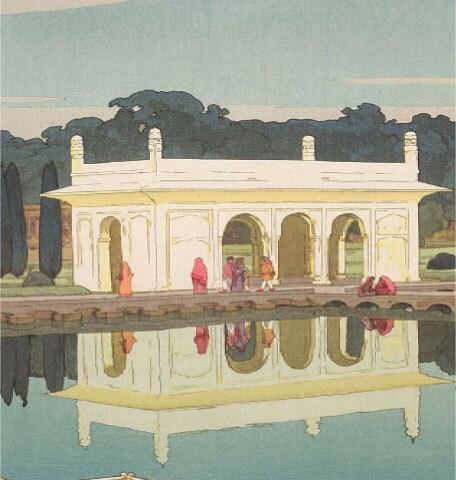
Shalimar Garden, also known as Shalimar Bagh, is one of the finest examples of Mughal garden design in South Asia. Located in Lahore, this historic garden was built in the 17th century by the Mughal emperor Shah Jahan. Today, it is recognized as a UNESCO World Heritage Site and remains one of the most visited historical places in Pakistan.
Shalimar Garden and Hiroshi Yoshida
In the early 20th century, Japanese artist Hiroshi Yoshida (1876–1950) created a famous woodblock print titled Shalimar Garden, Lahore. In this artwork, Yoshida beautifully captured reflections of people, trees, and marble structures on the calm surface of the water tank inside the garden.
What makes this print special is that it preserves details that no longer exist. The tall trees shown in the artwork have disappeared over time. The original marble pavilion seen in the print was damaged and looted during the period of Maharaja Ranjit Singh. Later, it was replaced, but even that replacement was eventually covered with lime plaster or red sandstone.
The Lost Marble Pavilion
At first glance, Yoshida’s print may appear to be an artistic imagination, because today the pavilion shown in his work is no longer visible at Shalimar Garden. However, older photographs published in 1908 confirm that a marble mahtabi (moonlight pavilion) once stood in the center of the water tank.
Historical images show that this central pavilion was connected to two marble structures on either side. Even these may have been later reproductions, as the original marble was removed and used in the construction of Ram Bagh in Amritsar. In a government publication from 2008, a marble roof can still be seen, though the pillars beneath it were already replaced with red stone.
Water, Light and the Mughal Vision
Water played a central role in the design of Shalimar Garden. Emperor Shah Jahan ordered the construction of a special canal to supply water to the garden’s fountains, pools, and channels. The careful use of flowing water, reflection, and light created a peaceful and cooling environment.
It is almost poetic that a Japanese artist traveled so far to capture this interaction of light and water. Yoshida was deeply interested in how natural elements behaved in different regions of the world, and one can imagine that Shah Jahan himself would have appreciated such attention to detail.
Yoshida and the Shin-Hanga Movement
After the end of Japan’s Edo period, traditional ukiyo-e woodblock prints began to lose popularity. To revive this art form, the shin-hanga (new prints) movement emerged, and Hiroshi Yoshida became one of its leading figures.
Although Yoshida was already successful as an oil painter and watercolor artist, he recognized growing interest in Japanese woodblock prints in the West. This led him to focus more on printmaking while traveling extensively across Europe, North America, India, and Southeast Asia during the 1920s and 1930s.
South Asia Through Yoshida’s Eyes
Yoshida’s South Asia series is unique. Unlike his earlier nature-focused works, these prints include mosques, temples, gurdwaras, traders, and everyday people. His Lahore scenes show both day and night views, as well as Afghan traders passing through the region.
In 1930, Yoshida traveled through northern India with his son, Toshi Yoshida. The resulting prints reflect a sense of spirituality, scale, and respect for the cultures he encountered.
Lasting Recognition
Interest in Yoshida’s South Asia prints has remained strong for decades. In 1999, the Smithsonian Institution’s Asian Art Museum exhibited all 32 prints from this collection. Later, in 2015, the Ashmolean Museum in Oxford displayed his works under the exhibition titled “Hiroshi Yoshida: A Japanese Artist in India.”
In 2024, the Ashmolean Museum acquired a print of Shalimar Garden, Lahore. As the centenary of Yoshida’s South Asia journey approaches, renewed interest in his work continues to grow, linking Japanese and South Asian artistic traditions.
Visiting Shalimar Garden Today
Today, Shalimar Garden remains one of Lahore’s most important historical attractions. Visitors can walk along its terraces, admire the fountains, and imagine how the garden once appeared during the Mughal era.
You can take a full day tour of Lahore from our site at https://www.travel-culture.com/tours/lahore_city_tour.shtml and visit Shalimar Garden. The tour also includes other major Mughal and colonial landmarks of the city.
Shalimar Garden is not only a place of beauty but also a meeting point of history, art, and cultural exchange — a garden that continues to inspire artists and travelers from around the world.



Advertisement
Advertise on this site click for advertising rates