
The decline of Bronze-Age civilizations in Egypt, Greece and
Mesopotamia has been attributed to a long-term drought that began around 2000 bc.
Now palaeoclimatologists propose that a similar fate was followed by the
enigmatic Indus Valley Civilization, at about the same time. Based on isotope
data from the sediment of an ancient lake, the researchers suggest that the
monsoon cycle, which is vital to the livelihood of all of South Asia,
essentially stopped there for as long as two centuries.
Experiment with distant quasar light could solve free-will loophole in quantum
theory More humane method needed for euthanizing lab fish Microbial genes become
useful forensic tool
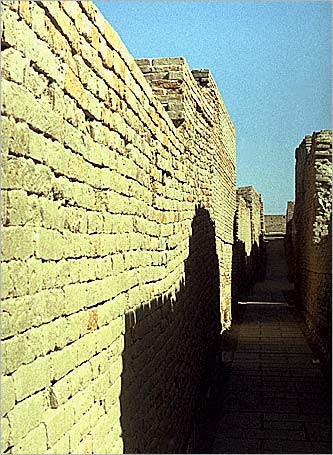
The Indus Valley, in present Pakistan and northwest India, was home to a
civilization also known as the Harappan Civilization. It was characterized by
large, well-planned cities with advanced municipal sanitation systems and a
script that has never been deciphered. But the Harappans seemed to slowly lose
their urban cohesion, and their cities were gradually abandoned.
The link between this gradual decline and climate has been tenuous because of a
dearth of climate records from the region. So Yama Dixit, a palaeoclimatologist
at the University of Cambridge, UK, and her colleagues examined sediments from
Kotla Dahar, an ancient lake near the northeastern edge of the Indus Valley area
in Haryana, India, that still seasonally floods.
The team assigned ages to sediment layers using radiocarbon dating of organic
matter. In various layers, they collected the preserved shells of tiny lake
snails (Melanoides tuberculata), which are made of a form of calcium carbonate
(CaCO3) called aragonite. The team also looked at the oxygen in the argonite
molecules, counting the ratio of the rare oxygen-18 isotope to the more
prevalent oxygen-16.
Kotla Dahar is a closed basin, filled only by rain and runoff and without
outlets. Thus precipitation and evaporation alone determine its water volume.
During drought, oxygen-16, which is lighter than oxygen-18, evaporates faster,
so that the remaining water in the lake and, consequently, the snails' shells,
become enriched with oxygen-18. The team's reconstruction showed a spike in the
relative amount of oxygen-18 between 4,200 and 4,000 years ago. This suggests
that precipitation dramatically decreased during that time. Moreover, their data
suggests that the regular summer monsoons stopped for some 200 years.
The result, reported last week in Geology1, supports the idea that monsoon
failure led to the civilization’s decline, although David Hodell, a co-author of
the study and a palaeoclimatologist also at the University of Cambridge, hastens
to add that uncertainties in the shell and archaeological records mean that the
dates could be off by some 100 years in either direction.
Anil Gupta, the director of the Wadia Institute of Himalayan Geology in Dehradun,
India, says that the work fills a gap in the geographic record of ancient
droughts. But large questions remain. “What drove this climate change 4,100
years ago? We don’t see major changes in the North Atlantic or in the solar
activity at that time.”
Recently, another team, led by palaeoclimatologist Sushma Prasad of the German
Research Centre for Geoscience in Potsdam, Germany, did a similar analysis on a
sediment core from Lonar Lake in central India2. They found that in that area,
drought began as many as 4,600 years ago. But the results are consistent with
those of Dixit’s group, Prasad says. “We see a drying event starting earlier,
but at about 4,200 years ago it became very intense.”
If a lack of monsoons did spell the end of the Indus Valley civilization, says
Hodell, “it is an example — and there are other examples of this — of how
ancient societies have had to contend with climate. There are some lessons for
us and our future, in which we will have to deal with anthropogenic climate
change”.
References
Dixit, Y., Hodell, D. A. & Petrie, C. A. Geology
http://dx.doi.org/10.1130/G35236.1 (2014).
Prasad, S. et al. Earth Planet. Sci. Lett. 391, 171-182 (2014).
Cite this article
Marris, E. Two-hundred-year drought doomed Indus Valley Civilization. Nature
(2014). https://doi.org/10.1038/nature.2014.14800