
The Forgotten Heritage of Multan
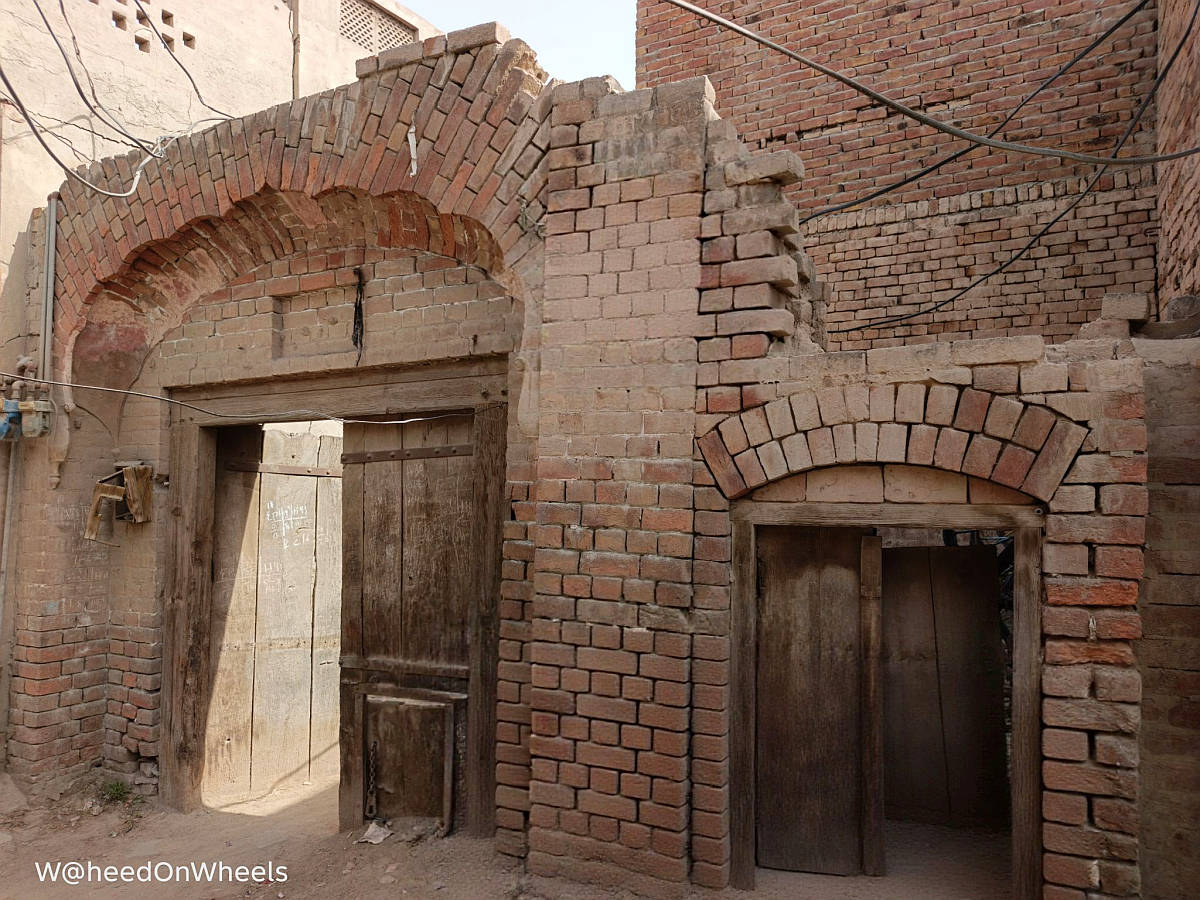
Searching for the History of “Shri Sewa Samiti Mantralaya” and the Old Mandi Gaushala
Multan, one of the oldest continuously inhabited cities in South Asia, is known for its shrines, ancient bazaars, and layered civilizations. Yet beyond its famous monuments lie forgotten corners of history—places hidden beneath modern markets and busy streets, carrying silent memories of communities that once flourished here.
Recently, an opportunity arose to visit one such historic location in the area of Old Mandi (Purani Mandi) in Multan. Accompanying the visit was senior tracker and explorer Mr. Mushtaq Ahmad Ansari, who shared vivid childhood memories connected to this place.
He recalled how, during his younger days, he and his friends used to play around this very gate. Whenever the large wooden doors were closed, they would cleverly enter through the smaller built-in opening within the gate.

A Historic Gateway Buried Beneath Time
Today, the passage of time has changed the landscape dramatically. Rising street levels and decades of urban development have partially buried this once-grand arched gateway beneath layers of earth and construction.
Yet despite the dust of history, the ancient wooden doors still stand—guarding untold stories and unanswered questions from Multan’s forgotten past.
The gate itself reflects architectural styles once common in old Multan, where community buildings, caravanserais, temples, and havelis formed part of a vibrant urban environment.

The Shri Sewa Samiti Mantralaya Complex
Before the Partition of India in 1947, this gateway formed part of a large and highly organized community complex managed by the Hindu welfare organization known as “Shri Sewa Samiti Mantralaya.”
At that time, the entire neighborhood was widely recognized as “Mohalla Purani Mandi Gaushala.”
Spread across a significant area, the complex contained multiple welfare, social, and religious facilities serving the local community and travelers alike.
The complex reportedly included:
- A “Janj Ghar” or community hall used for weddings and social gatherings
- A “Sarai Khana” for traders, pilgrims, and travelers arriving from distant regions
- A dedicated Gaushala for the care and protection of cows and animals
- A Temple and bathing pond for worship and ritual cleansing
This reflects the highly structured nature of pre-partition community life in Multan, where religious, charitable, and social institutions were often interconnected within a single civic space.

Memories of a Vanished Era
According to Mr. Mushtaq Ahmad Ansari, the entire historical complex remained intact until nearly 65 years ago, around the 1960s.
Afterward, the property was declared evacuee property following the migration period after Partition, and much of the land was eventually sold.
Over time, shops and commercial markets were constructed across the area. Today, even those markets have themselves become part of the old city’s heritage landscape.
However, amid all the transformation, the old gateway of the Janj Ghar survives as perhaps the last visible reminder of this once-vast community center.

The Missing Plaque and Unanswered Questions
A closer look at the gateway reveals another intriguing detail: above the doorway and beneath the arch is a clearly visible empty space where a commemorative plaque once existed.
That missing plaque likely carried the original name of the institution and the date of its construction.
Unfortunately, the plaque has disappeared, leaving behind only traces—and many unanswered historical questions.
Was This Facility Exclusive to One Community?
Was the Janj Ghar and Sarai Khana reserved only for the Hindu community before 1947? Or, as was common in the traditionally pluralistic society of Multan, did Muslim travelers and local residents also use these facilities for weddings, gatherings, and accommodation?
What Happened After Partition?
Following the migration and upheaval of 1947, what became of this place? Was it temporarily used to house refugees arriving from across the border, or did it remain abandoned for some time before commercial development began?
When Did the Complex Finally Disappear?
Exactly when did the Janj Ghar, Sarai Khana, temple, and Gaushala cease functioning? What was the final phase of social activity here before the structures disappeared into history?

Preserving the Forgotten Heritage of Multan
Multan has witnessed the rise and fall of many civilizations—Hindu, Buddhist, Sikh, Muslim, and colonial. Each layer has contributed to the city’s identity.
Sadly, many sites connected to the city’s non-Muslim heritage have faded from public memory over time.
Places like the old Shri Sewa Samiti complex are not merely abandoned structures; they are part of the social history of Multan.
They remind us of a period when the city’s neighborhoods were shaped by shared spaces, community welfare, religious coexistence, and civic organization.
Documenting these sites is essential not only for historians but for future generations who deserve to understand the complete story of their city.

A Call for Historical Contributions
If any elder, historian, researcher, or resident of the Purani Mandi Gaushala area possesses authentic information, old memories, documents, or photographs related to this site, the Shri Sewa Samiti organization, or the post-partition history of the complex, their contributions would be invaluable.
Only through collective effort can the incomplete story of this lost heritage be reconstructed.
Let us work together to preserve the hidden history of Multan before it disappears forever beneath the noise of modern development.
By: Muhammad Waheed Hussain Ansari
Waseb Explorer Multan
Waheed on Wheels
Disclaimer
This article is intended solely for historical awareness, educational purposes, and the promotion of research. The information presented does not seek to promote or represent any particular belief, ideology, or religious viewpoint.
Readers are free to form their own opinions and interpretations based on the available historical material.

Advertisement
Advertise on this site click for advertising rates