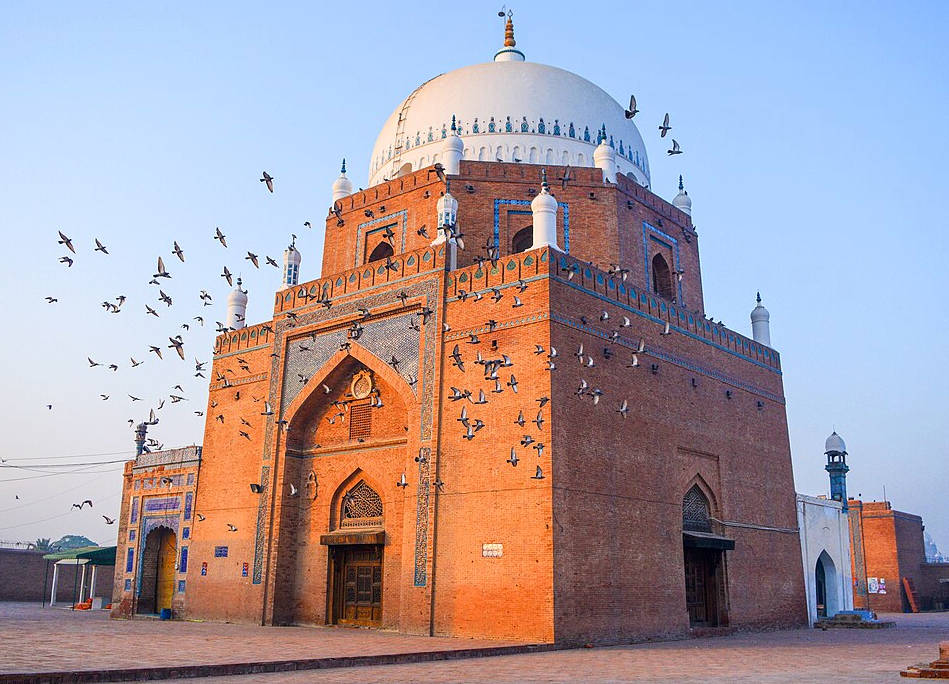
Multan, known throughout South Asia as the City of Saints, is one of the oldest cities in Pakistan and a center of spirituality, learning, and culture. Among its many historic landmarks, the Tomb of Hazrat Bahauddin Zakariya Multani stands as one of the city's most important spiritual and architectural treasures. Located within the historic Qasim Bagh Fort area, the shrine dominates the skyline of old Multan and attracts thousands of pilgrims and visitors every year.
The monument is dedicated to Hazrat Sheikh Bahauddin Zakariya Multani, one of the greatest Sufi saints of the Indian subcontinent and the leading figure of the Suhrawardi Order in the region. His teachings helped transform Multan into an important center of Islamic scholarship and spirituality.
Hazrat Bahauddin Zakariya was born around 1170 AD. In search of knowledge and spiritual enlightenment, he traveled extensively through the Islamic world, visiting Khurasan, Bukhara, Madinah, and Baghdad. In Baghdad he became a disciple of the famous Sufi master Sheikh Shahabuddin Umar Suhrawardi, from whom he received spiritual training.
Upon returning to Multan, Hazrat Bahauddin Zakariya established the Suhrawardi Order in the region and played a major role in promoting education, spirituality, and social welfare. His influence spread across the subcontinent and continues to be felt today.
The tomb was completed in 1262 AD and is considered one of the oldest surviving domed mausoleums in South Asia. Historians regard it as the earliest and most influential example of the distinctive Multani architectural style that later shaped the design of many shrines and monuments throughout Southern Punjab and the Indus Valley.
The monument became a model for later masterpieces, particularly the famous Tomb of Shah Rukn-e-Alam, another iconic landmark of Multan.
The mausoleum features a unique three-tiered design. The lower portion is built on a square plan, above which rises an octagonal drum supporting a large hemispherical dome. This innovative architectural arrangement was highly influential and became a hallmark of Multani architecture.
The structure is remarkable not only for its beauty but also for its engineering. Massive Sheesham wood beams were incorporated into the walls to strengthen the building. These beams continue to support the structure more than seven centuries after its construction.
Perhaps the most distinctive feature of the tomb is its stunning blue glazed tile work. The combination of red brick masonry and brilliant blue tiles has become an architectural symbol of Multan itself.
Experts believe that the tradition of blue glazed tiles arrived in Multan from Central Asia and Khurasan through cultural and trade connections. The technique flourished in Multan and later influenced architecture throughout the region.
The decorative patterns and vibrant colors continue to fascinate visitors and photographers from around the world.
The interior of the shrine contains elegant arches, finely crafted brickwork, and decorative elements inspired by the Muqarnas style commonly found in Islamic architecture. The craftsmanship demonstrates the remarkable skills of medieval builders and artisans.
The peaceful atmosphere inside the mausoleum provides a place of reflection and spiritual devotion for pilgrims and visitors alike.
During the British siege of Multan in 1848, the tomb suffered considerable damage from artillery fire. Several sections of the structure were affected during the bombardment of the city.
Fortunately, restoration work carried out in later years helped preserve this important monument. Today the tomb stands restored and remains one of Pakistan's most valuable architectural and cultural landmarks.
The Tomb of Hazrat Bahauddin Zakariya is one of the highlights of any tour of Multan. Visitors interested in history, Sufism, architecture, photography, and culture will find the monument particularly rewarding. Its elevated location within the historic fort complex also provides impressive views over the surrounding city.
The shrine is often visited together with other major attractions such as the Tomb of Shah Rukn-e-Alam, Multan Fort, Hussain Agahi Bazaar, Eidgah Mosque, and the city's famous blue pottery workshops.
Travel & Culture Services Pakistan offers guided tours of Multan and Southern Punjab for cultural travelers, heritage enthusiasts, educational groups, and international visitors. Our tours include visits to the Tomb of Hazrat Bahauddin Zakariya, Shah Rukn-e-Alam, historic bazaars, ancient mosques, museums, and traditional handicraft centers.
Working with international partners, including Spanish tour operators, Travel & Culture Services Pakistan promotes Pakistan's rich cultural and spiritual heritage through carefully designed tours that combine history, architecture, local culture, and authentic experiences.
The Tomb of Hazrat Bahauddin Zakariya is far more than a historic monument. It represents the spiritual legacy, architectural achievements, and cultural richness of Multan. More than seven centuries after its construction, the shrine continues to inspire visitors with its beauty and its connection to one of the greatest Sufi saints of the region.
[an error occurred while processing this directive]