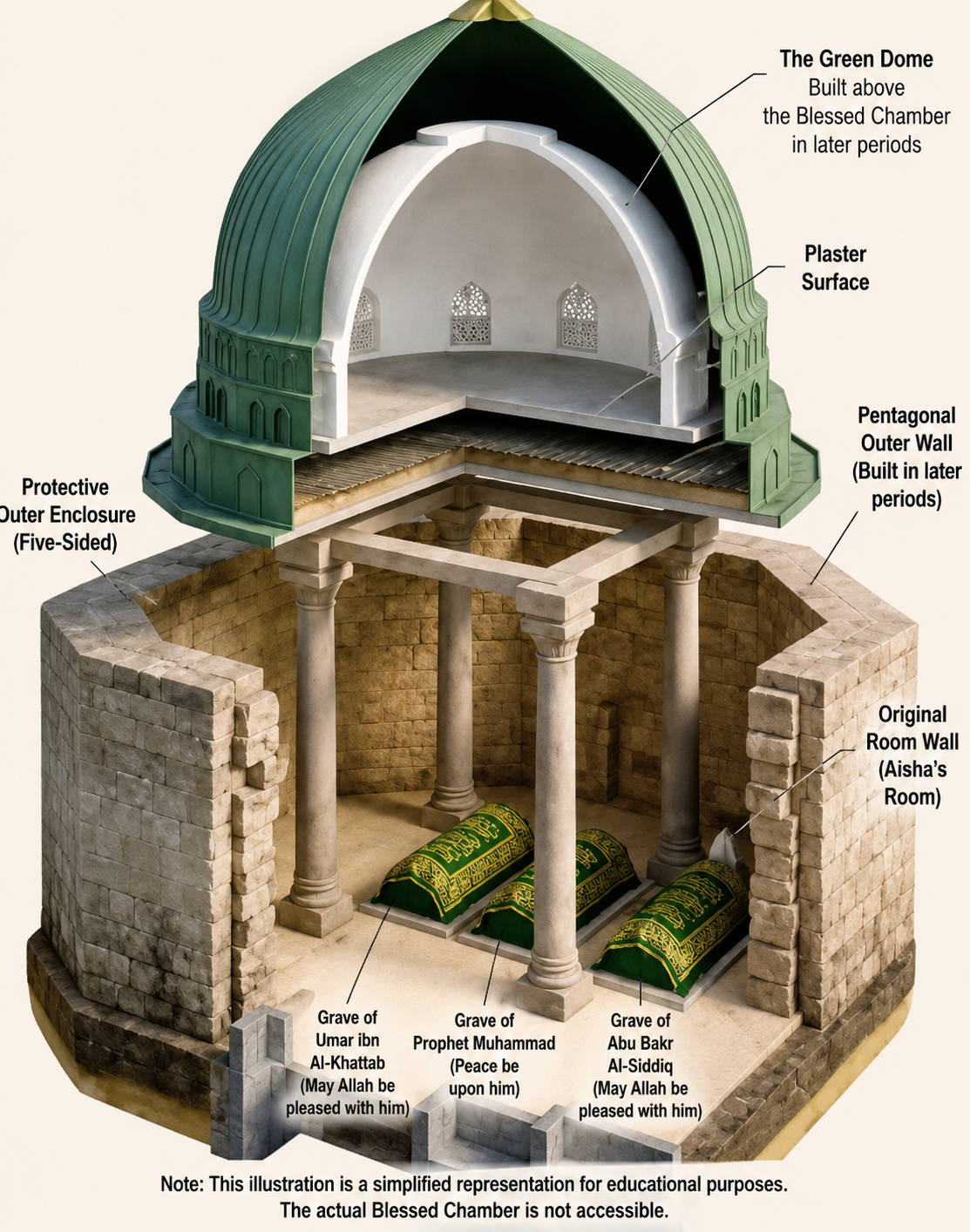
The resting place of Prophet Muhammad (peace and blessings be upon him) inside Al-Masjid an-Nabawi in Madinah is among the holiest locations in the Islamic world. Every year millions of Muslims travel to Madinah after completing or during their Umrah and Hajj journeys to offer their greetings (Salam) to the Messenger of Allah. Although countless pilgrims stand before the famous golden grille near the Rawdah, very few know the fascinating history of the Blessed Chamber (Al-Hujrah Al-Sharifah) that houses the graves of Prophet Muhammad (peace be upon him), Abu Bakr Al-Siddiq (may Allah be pleased with him), and Umar ibn Al-Khattab (may Allah be pleased with him).
The Blessed Chamber has remained one of the most carefully protected places in Islamic history. Over the centuries several protective walls were constructed around the original room to preserve its sanctity and prevent unauthorized entry. Because of these architectural protections, no authentic photograph of the Prophet's blessed grave exists, and according to historical records, no one has entered the innermost chamber since the fifteenth century.
Following the passing of Prophet Muhammad (peace be upon him) in 11 AH (632 CE), he was buried in the room of his beloved wife, Umm al-Mu'minin Aisha (may Allah be pleased with her). The Prophet himself had indicated that prophets are buried where they pass away, and therefore his burial took place in the same chamber where he spent his final days.
Later, the first Caliph, Abu Bakr Al-Siddiq, was buried beside him. Several years afterward, Umar ibn Al-Khattab was granted permission by Aisha (may Allah be pleased with her) to be buried alongside the Prophet and Abu Bakr. Today these three blessed graves remain inside the original chamber, which has been enclosed and protected for nearly fourteen centuries.
One of the questions frequently asked by Muslims around the world is why no authentic photograph of Prophet Muhammad's grave exists.
The answer lies in the extraordinary measures taken over many centuries to protect the Blessed Chamber. Visitors standing before the golden grille inside Al-Masjid an-Nabawi do not actually see the graves. Instead, they see a green curtain covering one of the outer protective walls. Between the visitors and the sacred graves stand several layers of solid masonry that prevent direct access or even a direct view.
As a result, the actual resting place of Prophet Muhammad (peace be upon him) has remained hidden from public view for centuries, preserving both its dignity and sanctity.
The original room of Aisha (may Allah be pleased with her), in which the Prophet is buried, is surrounded by multiple protective enclosures built during different periods of Islamic history.
The earliest enclosure consisted of the original walls of Aisha's room. During the Umayyad period, when Umar ibn Abd al-Aziz served as Governor of Madinah, another five-sided wall was constructed around the chamber. Historians explain that the unusual pentagonal shape was intentionally chosen so that the enclosure would not resemble the cubic shape of the Holy Kaaba.
Centuries later, another five-sided protective wall was added around the first enclosure, creating an additional barrier. None of these walls contain doors, making unauthorized entry virtually impossible.
Today, pilgrims standing before the famous golden grille are separated from the actual graves by several protective walls. Although the physical distance is only a few meters, the sacred chamber itself remains completely inaccessible.
The preservation of the Blessed Chamber is one of the greatest architectural achievements in Islamic history. Despite wars, political changes, natural disasters, and numerous expansions of Al-Masjid an-Nabawi, the original burial chamber has remained protected with immense care and respect.
Successive Muslim rulers ensured that every renovation of the mosque maintained the integrity of the Prophet's resting place while improving the facilities for the millions of pilgrims who visit Madinah each year.
Historical records indicate that access to the innermost chamber has been extremely rare. According to traditional accounts, one of the earliest recorded entries took place during renovations in 91 AH when Umar ibn Abd al-Aziz supervised restoration work.
The most detailed description, however, comes from the famous historian and scholar Nur al-Din Ali ibn Ahmad al-Samhudi (died 911 AH), whose monumental work Wafa al-Wafa bi Akhbar Dar al-Mustafa remains one of the most authoritative sources on the history of Madinah and Al-Masjid an-Nabawi.
During restoration work in 881 AH (1477 CE), weakening walls around the Blessed Chamber required reconstruction. This extraordinary event allowed Al-Samhudi to witness the chamber and record what he saw, leaving behind one of the most valuable historical descriptions available today.
One of the most important historical accounts describing the Blessed Chamber comes from the renowned historian and jurist, Nur al-Din Abu al-Hasan Ali al-Samhudi (844–911 AH / 1440–1506 CE). His celebrated work Wafa al-Wafa bi Akhbar Dar al-Mustafa is regarded by scholars as one of the principal historical references on Madinah, Al-Masjid an-Nabawi, and the Prophet's Mosque.
According to Al-Samhudi, restoration work became necessary in 881 AH (1476–1477 CE) because sections of the protective walls surrounding the Blessed Chamber had weakened over time. During the reconstruction, the outer pentagonal enclosure was dismantled, revealing cracks in the original walls of the chamber. As repairs continued, Al-Samhudi was among the few individuals permitted to enter the sacred enclosure under official supervision.
His account remains the last detailed eyewitness description recorded in classical Islamic literature.
Al-Samhudi writes that he entered the chamber from the northern side with great humility and reverence. He describes experiencing an extraordinary fragrance unlike anything he had ever encountered before. Following Islamic etiquette, he first offered greetings of peace to Prophet Muhammad (peace be upon him), then to Abu Bakr Al-Siddiq, and finally to Umar ibn Al-Khattab (may Allah be pleased with them both).
He records that the chamber was almost square in shape and constructed from dark stones similar in appearance to those used in the walls of the Holy Kaaba. The chamber itself had no entrance door, reinforcing its purpose as a permanently protected resting place.
His attention was naturally drawn toward the three blessed graves. According to his description, all three graves were nearly level with the ground. Only one area appeared slightly raised, which he believed marked the grave of Umar ibn Al-Khattab. The graves were covered only with ordinary earth, reflecting the simplicity encouraged in Islamic burials.
Although this description has been quoted by generations of historians, it should be understood within its historical context as the personal observations recorded by Al-Samhudi during the restoration project.
Al-Samhudi further records that the floor of the Prophet's Chamber consisted of reddish sand and lay approximately sixty centimeters lower than the floor level of Al-Masjid an-Nabawi. This difference in height reflects the original ground level of Madinah during the lifetime of Prophet Muhammad (peace be upon him), before centuries of mosque expansions gradually raised the surrounding floors.
The historian also mentions that during later restoration work, the original roof of the chamber was replaced with a durable teak wood structure. Above this roof, a smaller dome was constructed directly beneath the famous Green Dome, which has become one of the best-known symbols of Madinah.
The Green Dome, known in Arabic as Al-Qubbah Al-Khadra, stands above the Blessed Chamber and has become one of the most recognizable landmarks in the Islamic world.
The dome visible today is the result of several historical renovations. It was originally constructed centuries after the Prophet's lifetime and has undergone repairs and rebuilding during different Islamic dynasties. The distinctive green color that gives the dome its modern name was adopted during the Ottoman period.
Although the Green Dome identifies the location of the Blessed Chamber, it does not provide access to the chamber itself, which remains enclosed within multiple protective structures.
The Blessed Chamber is situated within a larger enclosed area inside Al-Masjid an-Nabawi. Access to this hall is through an eastern entrance facing the direction of Jannat al-Baqi Cemetery. The entrance is generally reserved for authorized personnel engaged in official duties.
Historical accounts mention several significant features inside this hall, including the Mihrab associated with Sayyidah Fatimah al-Zahra (may Allah be pleased with her). Various renovations carried out throughout Islamic history have preserved these features while ensuring the continued protection of the Blessed Chamber.
The green covering draped over one of the protective walls surrounding the chamber has also been replaced periodically. Modern coverings were installed during the twentieth century as part of maintenance and preservation efforts undertaken by the custodians of the Two Holy Mosques.
Following the completion of the reconstruction in 881 AH, the protective walls were permanently sealed once again. Since that time, historical records do not indicate any further authorized entry into the innermost chamber.
Consequently, for more than five and a half centuries, the actual resting place of Prophet Muhammad (peace and blessings be upon him), Abu Bakr Al-Siddiq, and Umar ibn Al-Khattab has remained protected behind multiple sealed walls. Pilgrims continue to offer their greetings from outside the enclosure in accordance with long-established Islamic tradition.
Islam teaches Muslims to honour and love Prophet Muhammad (peace be upon him) while directing all acts of worship solely to Allah. Visitors to Al-Masjid an-Nabawi come to offer greetings and prayers in accordance with Islamic teachings, remembering the life, message, and example of the Prophet.
The extensive architectural protections surrounding the Blessed Chamber also reflect the concern of early Muslim scholars and rulers that the Prophet's grave should never become an object of worship. Throughout Islamic history, preserving both the dignity of the Prophet and the purity of Islamic monotheism has remained a guiding principle in caring for this sacred place.
For many Muslims, a journey to Madinah is one of the most emotional moments of their lives. Although visiting Madinah is not a compulsory part of Umrah, millions of pilgrims include the city in their itinerary to pray in Al-Masjid an-Nabawi, visit the Rawdah, offer Salam to Prophet Muhammad (peace be upon him), and explore many of the historic sites connected with the early history of Islam.
Historic landmarks such as Quba Mosque, Qiblatain Mosque, Mount Uhud, the Seven Mosques, and Jannat al-Baqi provide visitors with a deeper understanding of the life of the Prophet and the development of the first Muslim community.
If you are planning to perform Umrah, choosing an experienced travel company can make your journey more comfortable and spiritually rewarding.
Travel & Culture Services offers carefully planned Umrah packages that include visa assistance (where applicable), flights, quality accommodation, airport transfers, and transportation between Makkah and Madinah. Whether you are travelling individually, as a family, or in a group, professionally arranged packages help pilgrims focus on their worship while experienced staff take care of the travel arrangements.
For information about available Umrah packages, hotel options, and current departures, visit:
Travel & Culture Services – Umrah Packages
The Blessed Chamber (Al-Hujrah Al-Sharifah) represents one of the most sacred and carefully preserved locations in the Islamic world. For nearly fourteen centuries, Muslim rulers, scholars, and custodians have ensured that the resting place of Prophet Muhammad (peace and blessings be upon him) remains protected with the utmost respect and dignity.
The multiple protective walls surrounding the original chamber were constructed not to conceal history but to preserve one of Islam's holiest sites for future generations. Although millions of Muslims stand only a few metres away when offering Salam inside Al-Masjid an-Nabawi, the actual graves remain behind several layers of masonry that have safeguarded them for centuries.
Much of what historians know about the architecture of the Blessed Chamber comes from the writings of the great historian Nur al-Din al-Samhudi, whose work Wafa al-Wafa bi Akhbar Dar al-Mustafa continues to be regarded as one of the most important historical references on Madinah. His account of the restoration carried out in 881 AH provides a rare glimpse into a place that has remained inaccessible ever since.
Today, visitors from every corner of the world come to Madinah not to see the graves themselves, but to offer greetings to the Messenger of Allah (peace and blessings be upon him), pray in one of Islam's holiest mosques, and reflect upon the life and teachings of the Prophet whose message transformed the world.
No. Visitors cannot see the actual grave. Several protective walls surround the original chamber, and only an outer curtain and enclosure are visible through the famous golden grille inside Al-Masjid an-Nabawi.
The chamber has been protected for centuries to preserve its sanctity, prevent damage, and ensure that the resting place of the Prophet remains treated with the highest respect.
No authentic photograph of the actual grave is known to exist because the innermost chamber has remained sealed for centuries.
The chamber contains the graves of Prophet Muhammad (peace be upon him), Abu Bakr Al-Siddiq (may Allah be pleased with him), and Umar ibn Al-Khattab (may Allah be pleased with him).
Nur al-Din Ali ibn Ahmad al-Samhudi (d. 911 AH / 1506 CE) was one of the greatest historians of Madinah. His book Wafa al-Wafa bi Akhbar Dar al-Mustafa remains one of the most authoritative historical sources on Al-Masjid an-Nabawi and the city of Madinah.
Visiting Madinah is not one of the obligatory rites of Umrah. However, millions of pilgrims choose to visit Al-Masjid an-Nabawi before or after completing Umrah to pray in the Prophet's Mosque and offer Salam to the Prophet Muhammad (peace be upon him).
Travel & Culture Services offers a range of Umrah travel packages, including assistance with travel arrangements, flights, hotels, and ground transportation. Visit https://www.travel-culture.com/umrah/ for the latest information.
Source Note: Much of the historical architectural information presented in this article is derived from the classical work Wafa al-Wafa bi Akhbar Dar al-Mustafa by the renowned historian Nur al-Din Ali ibn Ahmad al-Samhudi (d. 911 AH). Where historical accounts describe rare entries into the Blessed Chamber or architectural details observed during restorations, they are presented as reports preserved in this important historical source.
[an error occurred while processing this directive]