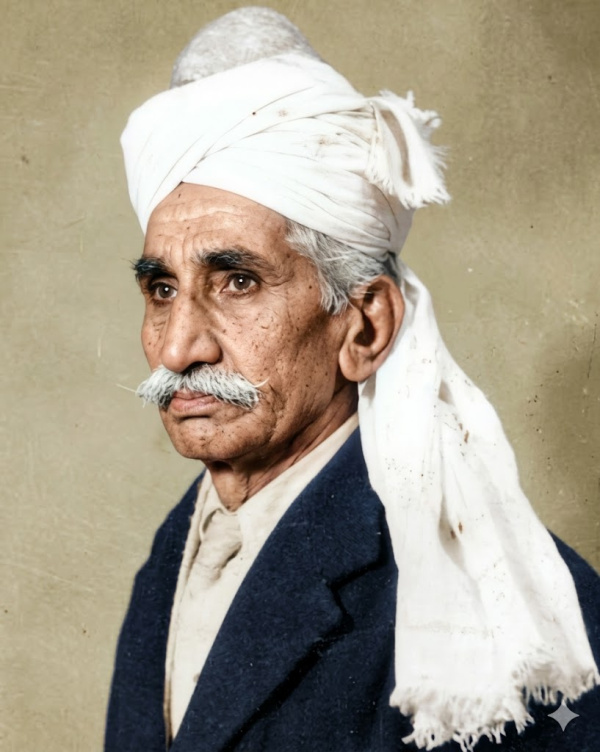
Talok Chand Mehroom is counted among the distinguished poets of Urdu literature who not only captivated hearts through his poetry but also earned respect for his simple lifestyle and deep love for humanity. His real name was Talok Chand, while “Mehroom” was his pen name. He was known for his broad-mindedness, tolerance, and universal outlook, always placing humanity above religious divisions.
Mehroom was born on July 1, 1887, in the small village of Musa Noor Zaman Shah in Mianwali District (Punjab, British India). The village, situated on the banks of the Indus River, frequently suffered from floods, leading to repeated destruction and rebuilding. Eventually, due to constant risks, his family migrated to Isa Khel.
From an early age, Mehroom was an exceptionally bright student. He enrolled in a vernacular middle school at the age of six or seven and consistently excelled in his studies, earning scholarships in both fifth and eighth grades.
In 1907, he passed his matriculation with distinction from Diamond Jubilee School in Bannu. He later joined Central Training College in Lahore, where he trained as a teacher and obtained his Bachelor’s degree.
In addition to Urdu, he developed proficiency in Arabic and Persian, particularly excelling in Persian. He was also well-versed in English literature and skillfully incorporated Western ideas into Urdu poetry.
Mehroom began his professional career in 1908 as an English teacher at Mission High School in Dera Ismail Khan. Due to family reasons, he later moved to Isa Khel.
In 1924, owing to issues such as the lack of clean drinking water, he relocated to Kalabagh and became the headmaster of a middle school there.
In 1933, when his son Jagannath Azad moved to Rawalpindi for higher education, Mehroom also transferred there and became the headmaster of the Cantonment Board School, later known as FG Technical High School (Tariqabad, Lalkurti).
After serving until 1943, he was appointed Lecturer in Urdu and Persian at Gordon College, Rawalpindi.
Following the partition of India in 1947, he migrated to Delhi. There, he briefly worked with the literary section of the newspaper “Tej” and later became a Professor of Urdu and Persian at Punjab University’s Camp College, serving until December 1957.
In 1953, he revisited Rawalpindi to attend the Golden Jubilee celebrations of Gordon College.
Mehroom’s poetic journey began without formal literary training, mainly due to the lack of libraries during his school years. While in Bannu, he gained access to the works of Mirza Ghalib and Muhammad Ibrahim Zauq, which refined his poetic taste.
He began writing poetry at a very young age, and his poem “Khidmat-e-Waliden” (Service to Parents), written at the age of 12–13, earned him recognition from teachers and educational authorities.
By the time he completed his education, his poetry was being published in notable journals such as “Makhzan” (Lahore) and “Zamana” (Kanpur).
During his stay in Rawalpindi, he regularly participated in annual literary gatherings in Lyallpur (now Faisalabad), alongside renowned poets like Jigar Moradabadi and Hafeez Jalandhari.
After the death of his wife, a deep sense of life’s impermanence entered his poetry. This emotional state is reflected in his famous poem “Ashk-e-Hasrat” from his collection “Toofan-e-Gham”.
His major collection “Ganj-e-Ma’ani” includes 175 poems, rubaiyat, qasidas, sehra, and elegies.
His work was praised by prominent literary figures including Niaz Fatehpuri, Allama Iqbal, Firaq Gorakhpuri, Kaifi Azmi, and Josh Malihabadi.
Mehroom’s poetry beautifully reflects human emotions, whether joy or sorrow. His ability to portray natural scenery is equally remarkable.
His language is refined, elegant, and impactful, enriched with well-placed Persian expressions. His attention to sound and rhythm adds musical beauty to his poetry.
Although born into a Hindu family, Mehroom grew up in a predominantly Muslim environment, which broadened his perspective.
He always emphasized humanity over religion. A notable example of his liberal outlook is the burial of his daughter Shakuntala according to Muslim rites rather than Hindu customs.
At his own funeral, people from different religions participated, and sacred texts from the Vedas, Gita, Quran, and Sikh scriptures were recited.
Though not directly involved in politics, his poetry reflects the political atmosphere of his time. Despite his close friendship with Allama Iqbal, he held independent views on certain political matters.
In 1962, the Government of Punjab (India) organized a special session in his honor during the annual “Sahitya Samaroh,” where he was awarded robes of honor, certificates, and cash prizes.
He had received several other awards for his literary contributions earlier as well.
After a prolonged illness, Mehroom passed away on January 6, 1966, in Delhi. His son, Jagannath Azad, donated his personal library to the Allama Iqbal Library at the University of Kashmir, where it is preserved as the “Talok Chand Mehroom Collection.”
O companion, do not ask about the tale of youth,
Like a gentle breeze, it came and passed away.
Hope entangled me in the snare of life’s sorrows,
I thought it had come as a blessing.
We cleaned temples and purified mosques,
But failed to cleanse the human heart.
Why reveal the secret of love to reason,
We never confide in strangers.
Talok Chand Mehroom remains one of those poets who connected their art with the message of humanity. His life and poetry continue to inspire values of tolerance, love, and intellectual openness.
— By Zia-ur-Rehman
[an error occurred while processing this directive]