
Sarah The Sindh Ibex
Sarah
Capra Hircus Linnacua, 1758; Wild Goat, Persian Pasang
Subspecies Capra Hircus blythi Hume, 1875, Sind Ibex
Description: Sindh Ibex is found in the dry mountainous areas of southern Balouchistan and Eastwards to Sind Kohistan, do not differ much in appearance from the wild goat populations found in certain remote island in the Eastern Mediteranean

They are rather stocky animals with thick-set bodies and strong limbs terminating in broad hooves, females and young males, till their second winter, are a yellowish-brown varying to reddish-grey with a darker brown mid dorsal line extending from between the shoulders to the base of the tail. The females are beardless but carry short backward curving horns which may measure upto 150mm (61in) over the curve and bear fine striations or annulations towards base. Mature male are spectularly beautiful, with long sweeping scimitar shaped horns over 102 cm (40 in) in length and almost silver white bodies offset by sorry grey chests, throat and face. The extent of white hair in the kind neck and body region of males increases with age. The hair in summer coat is short and coarse and even in adult males is more reddish-buff in color. In northern Kalat specimens develop considerable underwood in the winter coat. Adult males have a dorsal chest of longer buck and grey hairs which extend from a point just in front of shoulders to group. This tends to make old bucks look bigger and higher at the shoulder when views from a distance. The belly and outside of lower limbs, beard and forefront of the face varies fom black to to deep chestnut brown in mature males. There is also a conspicous black stripe in adult males, runing from whithers down the front of the shoulders merging with the black chest.

Females and younger males show characteristics of mussle and forehead with paler
yellow-grey line in between. This face pattern shows up well from a distance.
The himalian ibex does not have it. Older males however have most of face dark.
Specimens from Sindh Kohistan tend to be paler and much more slender in build
than the Balouchistan population with no under wool even in winter coat. The
horns which often describe a 270 arc, are strongly keeled in front, sweeping
upwards and outwards with the tips generally diverging.
The tail is very short and covered with long black radiating hairs, its under
surface is naked. It has been noticed that the sole of the hooves of fresh
killed species are whitish in color and of a rubbery consistency quite unlike
the hard hooves of wild sheep species. More over the second and fifth digits
consist only of rough rounded horny knobs which are quite loose and completly
detached from the cannon bone. Both these features appear to be valuable
ecological adoption for this animal's almost unbelievable acrobatic's skill in
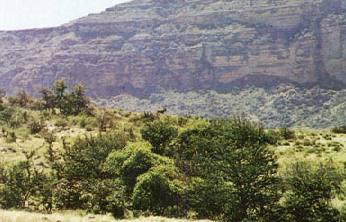
climbing or descending vertical rock cliffs. Specimens from the Khirthar range
in Sindh.
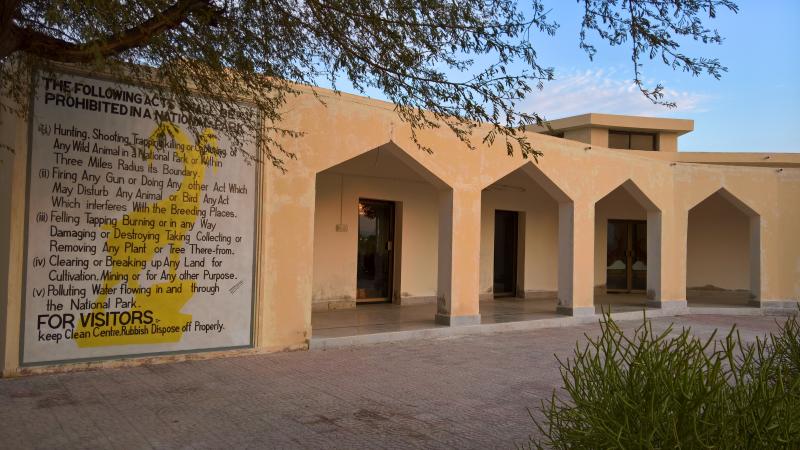
Khirthar National Park Kharchat center
Adult males of this species measure 1.3 to 4 meters (52 in) from nose tip to
root of tail, with the tail 12 to 15 cm (4.5 to 5.5 in) long. The shoulder
height in males from Sindh is 85 to 95 cm (33 to 37in) and females 55 to 60 cm
(21 to 23 in) Adult male may weigh upto 120KG (260 pounds) though 70 to 90kg
(154 t0 200 lb) would be about average and females weigh from 50 to 55 KG (111
to 120 lb).

The world record length of horn has shot in Khirthar range in Sindh in 1870 by General E.C Marson and Measured 133.4 cm (52.5 in) Witha basal girth of 17.8cm (7in). Another head measuring 133.2 cm (52 in) with a grith 19cm (7.5in) has shot in the same region in November 1912 (McCulloch, 1925). An average male has horns of about 107cm (42in) when fully mature.
Distribution and Status
They can survive almost at sea level and in fact do so in some of the remoter cliffs around Ormara. They inhabit mountain crests upto 11,000 ft in the Koh I Maran range Their main requirement seems to precipitous crags, where domestic goats and shepherds can not climb and where they can be safe from disturbance. They are capable of surviving in very arid desert regions where the vegetation is scarce
The most intriguing aspect of this species' distribution in Pakistan lies in the fact that its range meets that of the Markhor
A tour that will take you to the protected Khirthar National Park Kharchat center, near Karachi.
We will pick you up in Karachi at 8AM and
drive you to the Kharchat center of Khirthar National park, after fresh up
and tea we will explore the national park, witness Sindh ibex reptiles and
birds, picnic Lunch at the park later return to Karachi
Cost : Rs. 9200 per person or US$ 92 per person minimum 2 people required. Contact us to book now. Call us now at +92-321-2424778
What is Sindh Ibex or Sarah please read detailed article
Travel & Culture Services Pakistan
Online Hotel Booking
| Home | Tours
| MICE Conferences & Incentives | Islamabad | Karachi | Lahore | Peshawar| Quetta | Multan | Hyderabad | Hunza
| Gilgit | Chitral | Swat | Karakorum Highway | History | Archeology | Weather | Security | Contact Information |

Advertisement
Advertise on this site click for advertising rates