

Muzaffargarh Pakistan Travel Guide – History, Rivers, Heritage and Places to Visit
Muzaffargarh is one of the historic cities of southern Punjab, Pakistan. Founded in 1794 by Nawab Muzaffar Khan, the city takes its name from its founder and the fort around which the old settlement developed. The name Muzaffargarh literally refers to the "Fort of Muzaffar." :contentReference[oaicite:2]{index=2}
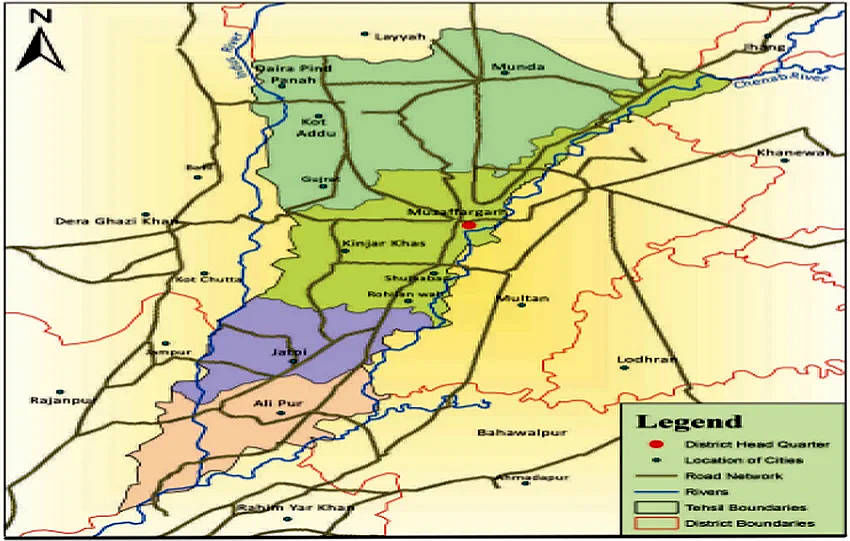
What makes Muzaffargarh particularly interesting geographically is its position between two of Pakistan's great rivers. The Chenab River forms its eastern side while the Indus River lies to the west. This has shaped the agriculture, settlements and history of the region. :contentReference[oaicite:3]{index=3}
For visitors, Muzaffargarh offers a combination of history, Sufi heritage, rural Punjab, river landscapes, archaeological monuments and agricultural scenery. The wider district contains historic sites at Sitpur, old forts, shrines and the impressive Sakina-Tu-Sughra Mosque.
Where is Muzaffargarh?
Muzaffargarh is located in southern Punjab between the Chenab and Indus rivers. The district lies close to Multan, Dera Ghazi Khan, Layyah, Jhang, Khanewal, Bahawalpur and Rajanpur.
The district's geographical position has given it an unusual character. Instead of being centered around one river valley, the wider Muzaffargarh region extends between two major rivers, with extensive agricultural land and settlements spread across the intervening area.
The official district profile lists agriculture, livestock and industries among the major components of the local economy. :contentReference[oaicite:4]{index=4}
A Brief History of Muzaffargarh
The history of modern Muzaffargarh begins in 1794, when Nawab Muzaffar Khan, the governor of Multan, founded the settlement.
The original town was established within the walls of a fort constructed by Nawab Muzaffar Khan. Before the development of the town, the location was associated with a small settlement and shop known as Musan Hatti on the road between Multan and Dera Ghazi Khan. :contentReference[oaicite:5]{index=5}
Muzaffargarh became a district in 1861 during the British period. Its location between the Chenab and Indus rivers made the surrounding region important for agriculture, communications and administration. :contentReference[oaicite:6]{index=6}
Following the independence of Pakistan in 1947, the district experienced major demographic changes as Hindu and Sikh communities migrated to India and Muslim refugees from different parts of India settled in the area. :contentReference[oaicite:7]{index=7}
Muzaffargarh – The City Between Two Rivers
One of the most distinctive features of Muzaffargarh is its geographical setting.
The Chenab River flows along the eastern side of the district while the Indus River forms its western boundary. This riverine environment has created fertile agricultural land and a distinctive rural landscape.
For travelers, the riverbanks and countryside provide an interesting contrast with the historic towns and monuments of southern Punjab.

Taunsa Barrage
Taunsa Barrage is one of the most important attractions associated with the wider Muzaffargarh region.
The barrage is situated on the Indus River and is an important irrigation and water-management structure. According to the Punjab Irrigation Department, its rehabilitation project was completed to ensure safe and sustained irrigation supplies to more than two million acres of fertile land in Muzaffargarh, Dera Ghazi Khan and Rajanpur districts. :contentReference[oaicite:8]{index=8}
The area around the barrage also provides opportunities for enjoying the river landscape and observing the relationship between water management and agriculture in southern Punjab.
Punjab's development planning has also included an eco-tourism and cultural park at Taunsa Barrage, reflecting the area's tourism potential. :contentReference[oaicite:9]{index=9}

Chenab West Bank Park
The Chenab West Bank Park is another recreational attraction associated with Muzaffargarh. It is located along the Multan–Muzaffargarh Road on the western bank of the Chenab River.
The Punjab Food Authority's district tourism material lists the park among the major attractions and notes recreational activities including camel rides and boat rides. :contentReference[oaicite:10]{index=10}
The park can be a pleasant stop for visitors looking for a more relaxed experience after exploring the city's historical sites.

Fayyaz Park
Fayyaz Park is located in the center of Muzaffargarh and is one of the city's principal public recreational spaces.
The official Muzaffargarh district website identifies Fayyaz Park as an important place in the city. :contentReference[oaicite:11]{index=11}
It is mainly a local leisure facility rather than a major historical monument, but it can easily be included during a short city tour.
Sakina-Tu-Sughra Mosque
One of the most visually distinctive religious buildings in Muzaffargarh District is the Sakina-Tu-Sughra Mosque in Kotla Reham Ali Shah, Jatoi Tehsil.
The official district website states that the mosque was constructed with the assistance of specialists from Turkey and identifies Dr. Ismail Bukhari as its founder. :contentReference[oaicite:12]{index=12}
The Punjab Food Authority's district tourism material describes the mosque as a large complex containing a mosque and school and notes its distinctive Turkish architectural influence. :contentReference[oaicite:13]{index=13}
Mahmood Kot Fort
The wider Muzaffargarh District contains several historic forts. One of the better documented examples is Mahmood Kot Fort.
The Department of Archaeology and Museums records Mahmood Kot Fort as a historic fort associated with the Mughal period. It is currently described as being in a poor state of preservation. :contentReference[oaicite:14]{index=14}
The fort is particularly interesting for travelers who want to explore lesser-known historic architecture away from the major tourist centers of Punjab.

Sitpur – Historic Town of Muzaffargarh District
Sitpur is one of the historic settlements in Muzaffargarh District and is particularly interesting for visitors interested in old architecture.
The area contains the Tomb of Tahar Khan Nahar and an associated historic mosque. These sites are included among Punjab's archaeological and heritage resources. :contentReference[oaicite:15]{index=15}
Sitpur provides an excellent opportunity to explore the lesser-known architectural heritage of southern Punjab.

Tomb of Sheikh Ladhu
The Shrine of Sheikh Ladhu is another important historic monument in Muzaffargarh District.
The Department of Archaeology and Museums describes it as a historic brick tomb dating broadly from the 1206–1526 CE period. The square tomb changes into an octagonal structure beneath a circular drum and dome. It is protected under the Punjab Special Premises Preservation Ordinance. :contentReference[oaicite:16]{index=16}
The monument is an excellent example of the lesser-known religious architecture of southern Punjab.

Nur Shah Tomb
Another historic monument documented by the Department of Archaeology and Museums is the Tomb of Nur Shah.
The tomb is constructed primarily of brick with mud mortar and has a square plan that transitions to an octagonal upper structure and dome. Its decorative elements include floral designs and a decorated wooden doorway. :contentReference[oaicite:17]{index=17}
Sites such as this demonstrate that Muzaffargarh's heritage extends well beyond the better-known attractions of the major cities of Punjab.
Other Historic Forts and Monuments
Muzaffargarh District has a surprisingly rich collection of lesser-known forts and historic sites.
Historical records and local heritage inventories mention sites associated with Shahgarh, Mahmood Kot, Khangarh, Dinpur, Daira Din Panah, Khan Kot and Sitpur. :contentReference[oaicite:18]{index=18}
Many of these structures are not developed as conventional tourist attractions and some are in poor condition. Travelers interested in visiting them should therefore arrange transportation and local guidance in advance.
Muzaffargarh and Sufi Heritage
Southern Punjab is famous for its Sufi traditions, and Muzaffargarh is part of this wider cultural landscape.
The district contains numerous shrines associated with religious personalities, including the Shrine of Sheikh Ladhu and other historic Sufi sites.
Visitors should remember that shrines are active religious places rather than simply tourist monuments. Appropriate clothing and respectful behavior are important.
How to Get to Muzaffargarh from Lahore
Muzaffargarh is approximately 430 kilometres from Lahore by road, depending on the selected route.
The most convenient option for tourists is normally a private vehicle, particularly if the itinerary includes Sitpur, Taunsa Barrage or other attractions outside the city.
Another practical approach is to travel toward Multan and continue by road to Muzaffargarh. Multan is a major transport center and is relatively close to Muzaffargarh.
How to Get to Muzaffargarh from Islamabad
Muzaffargarh is approximately 600 kilometres from Islamabad by road, depending on the route.
A private vehicle provides the greatest flexibility for tourists. Travelers can also use public transport connections through major Punjab cities.
For a cultural tour, we recommend breaking the journey rather than trying to cover the entire distance in one stretch.
How to Get to Muzaffargarh from Karachi
Muzaffargarh is approximately 850–900 kilometres from Karachi by road, depending on the route.
Travelers from Karachi can approach Muzaffargarh through Sindh and southern Punjab, or combine the visit with Bahawalpur and Multan.
For a longer southern Pakistan itinerary, Muzaffargarh can be included between Bahawalpur, Multan and Dera Ghazi Khan.
Distance to Muzaffargarh from Major Cities
| Starting City | Approximate Distance | Approximate Travel Time |
|---|---|---|
| Lahore | 430 km | About 6–7 hours |
| Islamabad | 600 km | About 8–9 hours |
| Karachi | 850–900 km | About 11–13 hours |
| Multan | 40–45 km | About 1 hour |
| Dera Ghazi Khan | 100 km | About 1.5–2 hours |
| Bahawalpur | 130 km | About 2–3 hours |
| Layyah | 110 km | About 2 hours |
| Jhang | 160 km | About 3 hours |
Distances and travel times are approximate and depend on the selected road, traffic and exact starting point.
Hotels in Muzaffargarh
Muzaffargarh has a selection of local hotels and guesthouses suitable for travelers making a short stay in the city.
Travelers looking for a larger selection of modern hotels can also consider staying in nearby Multan, which offers a much wider range of accommodation.
For private tours, Travel & Culture Services can arrange accommodation according to the traveler's preferred standard and itinerary.

How to Explore Muzaffargarh in One Day
A one-day tour of Muzaffargarh should combine the city with one or two attractions in the surrounding area. Because the district is large, attempting to visit every historic site in one day is not practical.
Morning – Muzaffargarh City
Begin with a drive through the central city and learn about the history of the settlement founded by Nawab Muzaffar Khan.
Late Morning – Fayyaz Park
Visit Fayyaz Park in the center of the city for a short break.
Midday – Lunch
Have lunch at a local restaurant and sample traditional Punjabi and Saraiki-influenced dishes.
Afternoon – Chenab River
Drive toward the Chenab River and, where appropriate and accessible, visit the Chenab West Bank Park.
Late Afternoon – Historical Excursion
If time allows, continue toward a nearby historic site such as Mahmood Kot or another heritage location arranged in advance.
Evening – Return to Muzaffargarh
Return to the city for dinner or continue onward to Multan.
Suggested One-Day Muzaffargarh Itinerary
| Time | Activity |
|---|---|
| 08:00 | Breakfast and begin Muzaffargarh city tour |
| 09:00 | Explore central Muzaffargarh and historic areas |
| 10:00 | Fayyaz Park |
| 11:00 | Continue toward Chenab River |
| 12:30 | Lunch |
| 13:30 | Chenab West Bank Park |
| 15:00 | Historical site excursion |
| 17:00 | Return toward Muzaffargarh |
| 18:00 | Local market / city sightseeing |
| 19:00 | Dinner or onward travel |
Two-Day Muzaffargarh Heritage Itinerary
Travelers with more time can make a much better exploration of the district by staying overnight.
Day 1: Muzaffargarh city, Fayyaz Park, Chenab River and Chenab West Bank Park.
Day 2: Visit historical sites such as Mahmood Kot, Sitpur and selected shrines, depending on accessibility and local conditions.
For visitors interested in nature and engineering heritage, Taunsa Barrage can be included as a separate excursion.
Muzaffargarh and Multan
Muzaffargarh is very close to Multan, making it easy to combine the two cities.
Multan is one of Pakistan's great historic and Sufi cities, while Muzaffargarh offers a contrasting experience centered around rivers, agriculture, rural settlements and lesser-known historic monuments.
A particularly good route is:
Lahore → Multan → Muzaffargarh → Dera Ghazi Khan
For a longer southern Punjab tour:
Lahore → Multan → Muzaffargarh → Taunsa → Dera Ghazi Khan → Fort Munro
Local Culture and Food
Muzaffargarh lies within the cultural region of southern Punjab where Punjabi and Saraiki traditions overlap.
The local cuisine includes traditional dishes such as saag, roti, daal, rice dishes, grilled meat, lassi and traditional sweets.
The markets and roadside restaurants provide opportunities to experience everyday local food and hospitality.
Agriculture Around Muzaffargarh
Agriculture is one of the foundations of the district's economy. The official district profile lists more than 1.18 million acres of total agricultural land area, with approximately 786,000 acres cultivated. :contentReference[oaicite:19]{index=19}
The rivers and irrigation network have played a fundamental role in making the area productive.
Travelers driving through the district will see extensive fields, villages, irrigation channels, orchards and agricultural activity.
Muzaffargarh for Nature Lovers
Muzaffargarh's greatest natural attraction is its river environment.
The Chenab and Indus rivers provide scenic landscapes, while the barrage and irrigation infrastructure demonstrate how water has shaped agriculture in southern Punjab.
The Punjab Forest, Wildlife and Fisheries Department also lists fishing opportunities at locations in Muzaffargarh District, including Taunsa Barrage, Head Muhammad Wala and Punjnad Headworks. :contentReference[oaicite:20]{index=20}
Visitors interested in fishing should check current local regulations and obtain any necessary permissions before fishing.
Best Time to Visit Muzaffargarh
The best time to visit Muzaffargarh is generally from October to March, when temperatures are more comfortable for outdoor sightseeing.
The summer months can be extremely hot. During hot weather, sightseeing around the rivers and historic sites should be planned for the morning and late afternoon.
Travel Tips for Muzaffargarh
- Combine Muzaffargarh with Multan for a stronger cultural itinerary.
- Allow extra time if visiting Taunsa Barrage.
- Private transportation is recommended for visiting remote historical sites.
- Carry drinking water during the warmer months.
- Wear modest clothing when visiting shrines and mosques.
- Ask permission before photographing people at religious sites.
- Check local access conditions before visiting lesser-known forts.
- Confirm accommodation before traveling.
- Use a local guide for archaeological and historic sites where appropriate.
Muzaffargarh for Photographers
Muzaffargarh offers excellent opportunities for documentary and landscape photography.
The contrast between the Chenab and Indus rivers, agricultural fields, irrigation channels, old settlements, shrines and historic monuments creates a very different photographic experience from the major urban centers of Punjab.
The riverbanks are particularly attractive during the softer light of early morning and late afternoon.
Suggested Punjab Travel Routes Including Muzaffargarh
Route 1 – Southern Punjab:
Lahore → Multan → Muzaffargarh → Dera Ghazi Khan
Route 2 – Southern Punjab Heritage:
Lahore → Multan → Muzaffargarh → Taunsa → Dera Ghazi Khan → Fort Munro
Route 3 – Rivers and Heritage:
Multan → Muzaffargarh → Chenab River → Taunsa Barrage → Dera Ghazi Khan
Muzaffargarh and Taunsa Barrage
For travelers interested in engineering, agriculture and the geography of Pakistan, the Taunsa Barrage excursion is particularly worthwhile.
The barrage demonstrates how major water-control structures have transformed the agricultural landscape of southern Punjab. The Punjab Irrigation Department notes that the barrage supports irrigation over more than two million acres of fertile land in the surrounding region. :contentReference[oaicite:21]{index=21}
It can therefore be viewed not only as a scenic destination but also as an important part of the economic and environmental history of the region.
Tour and Travel Arrangements in Muzaffargarh
Travel & Culture Services can arrange private transportation, hotels, guides and customized tours to Muzaffargarh and throughout Punjab.
We can arrange visits to Muzaffargarh, Taunsa Barrage, Sitpur, Mahmood Kot, Chenab River, Multan, Dera Ghazi Khan and other cultural destinations.
Muzaffargarh can also be incorporated into longer Pakistan tours covering Lahore, Multan, Bahawalpur, Cholistan, Dera Ghazi Khan and southern Punjab.
For any help or arrangement for tours in Muzaffargarh, Punjab or anywhere in Pakistan, please contact Travel & Culture Services.
Frequently Asked Questions About Muzaffargarh
Where is Muzaffargarh located?
Muzaffargarh is located in southern Punjab, Pakistan, between the Chenab River to the east and the Indus River to the west.
What is Muzaffargarh famous for?
Muzaffargarh is known for its history, agricultural landscape, rivers, Taunsa Barrage, historic shrines, forts and lesser-known heritage sites.
Who founded Muzaffargarh?
Muzaffargarh was founded in 1794 by Nawab Muzaffar Khan, the governor of Multan. The city was named after its founder and the fort around which the old settlement developed. :contentReference[oaicite:22]{index=22}
What are the main places to visit in Muzaffargarh?
Important attractions include Taunsa Barrage, Chenab West Bank Park, Fayyaz Park, Sakina-Tu-Sughra Mosque, Mahmood Kot Fort, Sitpur and several historic shrines.
What is Taunsa Barrage?
Taunsa Barrage is a major water-management and irrigation structure on the Indus River. It is important for irrigation, agriculture and water management in the surrounding region. :contentReference[oaicite:23]{index=23}
What is Mahmood Kot Fort?
Mahmood Kot Fort is a historic fort in Muzaffargarh District associated with the Mughal period. The Department of Archaeology and Museums records it as a historic monument currently in a poor state of preservation. :contentReference[oaicite:24]{index=24}
What is the Shrine of Sheikh Ladhu?
The Shrine of Sheikh Ladhu is a historic brick tomb in Muzaffargarh District dating broadly from the 1206–1526 CE period. It is a protected historic monument. :contentReference[oaicite:25]{index=25}
How far is Muzaffargarh from Lahore?
Muzaffargarh is approximately 430 kilometres from Lahore by road, depending on the route.
How far is Muzaffargarh from Islamabad?
Muzaffargarh is approximately 600 kilometres from Islamabad by road, depending on the route.
How far is Muzaffargarh from Karachi?
Muzaffargarh is approximately 850 to 900 kilometres from Karachi by road, depending on the selected route.
Is Muzaffargarh worth visiting?
Yes, particularly for travelers interested in southern Punjab, rivers, rural landscapes, Sufi heritage, archaeology, historic forts and destinations away from the usual tourist routes.
Can Muzaffargarh be visited as a day trip from Lahore?
It is possible as a long day journey, but an overnight stay is recommended if you want to explore the city's surrounding heritage and river attractions properly.
Can Travel & Culture arrange a Muzaffargarh tour?
Yes. Travel & Culture Services can arrange transportation, hotels, guides and customized tours to Muzaffargarh, Taunsa Barrage, Multan, Dera Ghazi Khan and other destinations in Pakistan.


Advertisement
Advertise on this site click for advertising rates