Roshan Ara Begum
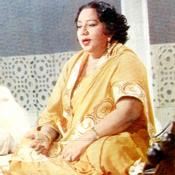 Roshan
Ara Begum, originally named Waheedunnisa Begum, was born in Bombay. She lived in
an environment that was alive with music. Her mother, Chanda Begum, a singer of
repute, was quick to discern her daughter's musical talent. She brought her to
Ustad Abdul Karim Khan, an eminent representative of the Kirana gharana, who
accepted her as a pupil and prayed, "O Allah, let this girl illumine the world
of music, and let your light rest upon her throat." Her mentor's prayer was more
than amply answered, and she became known as Roshan Ara (Decorator of Light).
Roshan
Ara Begum, originally named Waheedunnisa Begum, was born in Bombay. She lived in
an environment that was alive with music. Her mother, Chanda Begum, a singer of
repute, was quick to discern her daughter's musical talent. She brought her to
Ustad Abdul Karim Khan, an eminent representative of the Kirana gharana, who
accepted her as a pupil and prayed, "O Allah, let this girl illumine the world
of music, and let your light rest upon her throat." Her mentor's prayer was more
than amply answered, and she became known as Roshan Ara (Decorator of Light).
She made her debut as a singer in Bombay, where her songs were broadcast on
radio. In 1936 she found an opening as a playback singer for the famous director
Sohrab Modi in his historical film, “Pukar”. Later, she rendered Firoz Niazami's
compositions for the films “Jugnu” and “Kismat”.
In 1944, she received an offer of marriage from a music lover, Chaudhry Ahmed
Khan, a senior police officer in Bombay. She consulted her teacher, Ustad Abdul
Karim, and agreed to be married on one condition: that she would not give up
music. She kept her promise and continued to sing throughout her life. After
independence, she and her husband came to Pakistan in 1948 and settled down in
Lalamusa, a small town between Gujrat and Jhelum in Punjab. Though universally
acclaimed as "Malika Mauseequi" (Queen of Music) in Pakistan and Saraswati (a
goddess of the Hindu Pantheon) in India, she was a remarkably simple person. Her
humility, sincerity, and gentleness added to her stature as an artist. A devout
Muslim, she was an early riser and began her riyaz (musical practice) after her
morning prayers. Being childless, she adopted a boy and girl, upon whom she
showered her maternal love.
As a vocalist, the most important feature of her singing was her stress on
melody. She had an outstanding dexterity and control over a wealth of ragas. At
a l954 musical conference in Bombay, her renditions of Jinjhoti Thumri and Bhairvi
Thumri, the raga for which she is still considered the ultimate interpreter,
astonished a group of distinguished Ustads and Pundits with her divine and
soul-stirring voice.
While the Pakistani public has been more receptive to Salamat Ali Khan,
Amanat Ali Khan, and Fateh Ali Khan, these masters still listen to Roshan Ara's
recordings for their own entertainment. She won the President's Pride of
Performance Award in 1960 and was the first female vocalist to be awarded the
Sitara-e-Imtiaz.
Roshan Ara Begum's death of a heart attack on 6 December 1982 left the Kirana
gharana in Pakistan totally bereaved, although there are still a few exponents
of this school of music in India
More about Pakistan Music
History of Pakistani Music.|
Musical Instruments of Pakistan
|
Ustad Bare Ghulam Ali
Khan |
Ustan Fateh Ali Khan
|
Roshan Ara Begum
|
Ustad Salamat Ali Khan
|
Semi Classic Music of Pakistan
|
Light Music
|
Abida Parveen
This site contains information & guide to every city of Pakistan. News articles and
a lot of information. Please click the related links below.
Pakistan Profile (Basic information about Pakistan
Population, GDP Geography etc.)
Flag of Pakistan, Map of Pakistan
Maps of Pakistan
History of Pakistan (Chronological history of Pakistan)
Archeology of Pakistan
Old Punjab Images
Museums in Pakistan
Provinces (Information about the culture of each
province)
Distances between major cities of Pakistan
Weather information
Airports of Pakistan.
Land communication (Railroads & Highways)
Gardens in Pakistan
Mountains of Pakistan
Pakistan Currency Notes
Hotels In Pakistan.
Custom Rules in Pakistan
Baggage Rules
Import of personal vehicles
Punjabi Sufi Poetry
Sindhi Sufi Poetry
Music Of Pakistan
Urdu
phrases for Tourists


Advertise on this site click for advertising rates

